Albania

31st AUGUST 2018

I’d been promised a cooked breakfast on the morning I leave Montenegro, but Irena has just worked a night shift and I’d rather not wake her. I try to move all my gear downstairs silently, but she must hear me moving around and comes down to cook. I feel so guilty as she is clearly exhausted and has the worst case of early morning stares. She prepares her standard fried eggs, sausage and cheese while standing there like a yawning zombie. It’s not exactly gourmet, but I do appreciate the effort, and it’s good to see her before I leave.

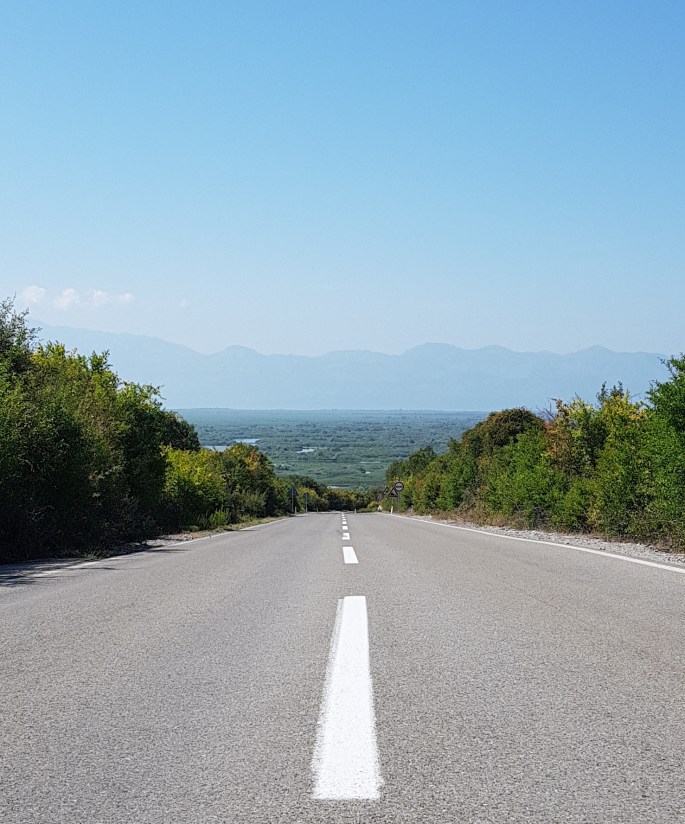
The road out of Podgorica is flat and hot to begin with, before it starts to climb through Mediterranean type scrub on its way up to the border. I’m now cycling above an inlet of the gigantic Lake Shkodër and, looking back, I can see its vast wetlands stretching away for miles into the distance. I’ve been slogging up this hill very slowly and gently, in an effort to preserve my warped rear wheel. All this restraint goes out the window though on a fast, steep descent to the border post. I’m such a sucker for a speedy downhill, despite the potential consequences.

Officially, you are supposed to register with the local police within twelve hours of entering Montenegro. This is normally done for you by your accommodation, but I don’t think that Guesthouse Zvono even looked at my passport, and I know that Irena didn’t. Bugger. Knowing that I’m not registered means I approach the border feeling shifty and paranoid, in much the same way that people do when they happen to be followed by a police car. Hopefully the border post officials have no way of checking my registration status. And if they can check, hopefully they won’t care.

There’s a queue of about six cars, so I join that, keep my bike helmet on and get under the shade of the border post roof as quickly as I can. Of course, after all my worries about registration, the Montenegran official stamps me out the country without a second glance. Then it’s a slow freewheel for a hundred metres to the Albanian checkpoint. I join the car queue and stand in the blazing sun once again. Luckily, a border policeman sees that I’m melting and beckons me to the front of the queue to be processed more quickly. It’s only a small gesture, but this helpfulness is a good first impression to take with me into Albania.

Let’s be honest here. Albania doesn’t have a great reputation. I’d received messages from a couple of concerned friends before I arrived, asking if it was wise to travel here and warning me to be careful. It seems that most people’s perceptions are that of a former communist state, run by the Albanian Mafia and rife with guns, drugs and organised crime. The series of ‘Taken’ films, full of ruthless Albanian human traffickers, wouldn’t have done much to encourage tourism either.

Now, I’d like to think that I’m open minded enough not to pre-judge a country, but I also know that this reputation must be based on some degree of truth. My viewpoint is that Albania is still a bit of a mystery to most people. After all, the country isolated itself from the rest of Europe for almost fifty years under communism. It only became accessible again in the early nineties, so it’s hardly surprising that people know very little about the place. Nevertheless, this bad reputation has led to my own perceptions of Albania becoming slightly biased. It seems silly to be entering a country with a slight feeling of unease, when that’s mostly based on opinions of people who have never set foot here. Still, I’m sure the local Mafia will have more pressing concerns than a sweaty bloke on a bike cycling through their country.

Across the border the scenery remains dry and scrubby, with a range of spiky mountains rising to my left and the vast, shimmering Lake Shkodër far off to my right. There’s a stark beauty to the surroundings, but this outlook is ruined by masses of litter cluttering the roadsides. Lay-bys and parking areas are particularly bad, where it’s sometimes difficult to see the asphalt with the amount of rubbish strewn upon it. Despite this throng of litter the roads are actually pretty good for cycling, with surprisingly smooth surfaces and a metre-wide margin at the side of the road to keep me separated from traffic.

About 30km after the border I reach the city of Shkodër and my destination for today. I find my accommodation on a run-down side street that sits between two of the main roads into the city centre. Although the street looks a little unwelcoming, my guesthouse is an oasis of modern comfort that has only been open four months. The building is a sparklingly clean two storey affair, with security gates and air-conditioning. Amazingly, all this luxury comes for around £13 per night with breakfast included.

At check-in I’m unable to pay cash as I haven’t had the chance to get any Albanian currency yet. I ask the reception girl if it’s alright to pay by card, and she astounds me by replying ‘Easy-Peasy Lemon Squeezy !’ This phrase is practically unheard of outside the UK, no matter how fluent someone’s English is, and I’m so surprised that I just laugh. It turns out that she grew up attending a private Turkish school, where she started learning English from her very first day. One of her language teachers had studied in the UK, and it’s their influence that means she can now rattle off obscure English phrases at will.

Getting my hands on some Albanian money is my next priority, so I take a ten minute walk into the city. This time the currency I need is Albanian Lek, which operates under an awkward-ish exchange rate of about 150 Lek to the pound. I withdraw 15,000 Lek, with the machine deciding to give me this in the form of three 5,000 Lek notes. I make a mental note to stop asking for such round figure amounts in future, and that way I’ll avoid getting all my cash in these large denominations.

Walking round Shkodër, I notice a real mixture of rich and poor. There’s some flashy cars in town and lots of well-dressed people walking round with snazzy phones. The flip-side of this is that I see a number of poor souls raking through bins for recyclable cans and bottles so they can get money back on them. There’s even an old guy who looks like a rag and bone man, complete with horse and cart, who’s rummaging through a skip for anything that might be remotely useful. Walking back to the guesthouse I stop at a supermarket to buy a bit of road food for tomorrow. The checkout girl isn’t best pleased that I only have a 5,000 Lek note to pay for a handful of items.

However, the checkout girl was the only grumpy person I’ve met since crossing the border. Everyone else has been friendly. I’m pleasantly surprised that today I’ve had more people toot their horn, wave, or say ‘Hello’ than on any other day of the trip. I think Albania might just make a mockery of its bad reputation.


Planet Montenegro

28th AUGUST 2018

My day off in Plužine begins with breakfast being served in the quirky guesthouse restaurant. The owners have chosen an odd combination of themes, as it seems they’re trying hard to fuse together jazz music with images of old Yugoslav revolutionaries. My favourite feature though is the vine trellis ceiling, which means there are numerous bunches of fat, purple grapes hanging down into the restaurant. I have a basic cooked breakfast of bacon and eggs, but here it’s accompanied by red peppers, cucumber, soft cheese and a glass of plain black tea. After cycling for so many weeks in Europe, I’ve now given up asking for milk in my tea.

As usual, one of my first tasks in a new country is to get my hands on some local currency. Montenegro uses the Euro, even though the country is not part of the EU, and even though the EU has told them that they’re not allowed to use it. Montenegro has essentially turned round and said ‘Screw you, we’re just gonna use it anyway !’ The European Union have turned a bit of a blind eye, as Montenegro have applied to join the EU and should still end up with the Euro as their currency eventually. It would seem a bit pointless forcing them to change currencies, only for Montenegro to become EU members and have to change back to the Euro again. Personally, I’m glad they’ve hijacked the Euro as it’s an easy currency to work with regarding prices and exchange rates.

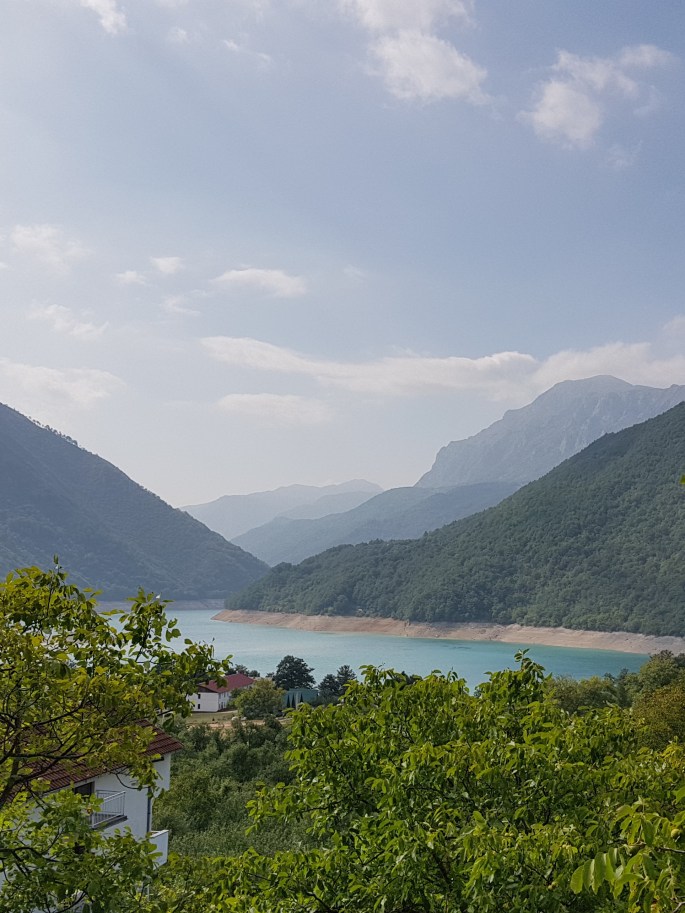
Back at the guesthouse I do a long-overdue clothes wash and hang them out to dry between a couple of pear trees in the orchard. Then I walk down to Piva Lake, where the low water level has exposed a large band of tan-coloured rock all around the shoreline. This band looks a little ugly when I’m close up, but the sandy colour creates a great contrast, wedged between the turquoise blue lake and the surrounding green mountains. In the late afternoon I brave another irritating jazz sountrack and visit the restaurant for a beer and a sandwich. The girl who serves me pronounces it as ‘Sendvich’ with her accent, which is quite cute. Then, when I go to pay she gives me a handwritten receipt that says I ordered one Beer and one Sendvić.

The next morning I discover that I have enough left-over snack food to last me for days, so I don’t need a restaurant breakfast to send me on my way. Getting out of Plužine is a slow trudge up a hill that winds its way above the settlement, but then gives me some amazing views back down over the town and Piva Lake. I’m sweating like a pig already, even though I’ve only been cycling for half an hour. It’s already shaping up to be a hot, cloudless day. The road continues in a generally uphill fashion for the next 30km, which takes me from an altitude of 750 metres in Plužine, right up to 1,200 metres at the summit. (That’s almost 4,000 feet in UK-speak)

I’m nearing the end of a high plateau when I meet a group of guys working on the road. One bloke attempts a mime to tell me what to expect up ahead. First he motions a downhill, then an uphill, before he spreads his arms out wide and shouts ‘Montenegro !’ I think he’s saying that it’s all downhill after the next climb, and then I’ll have all of Montenegro within my reach below me. He’s right too, as the next 30km are a cracking descent through spectacular landscapes of dry, jaggy mountains, fertile farmland and terracotta tiled houses. I’m loving these downhills, although I’m still being a bit careful with my speed after my rear tyre issues. I’ve also just noticed that my back wheel is buckled quite badly after carrying all my heavy gear for weeks. I have nightmarish visions of it buckling completely and just collapsing under all the weight.

The downhill carries on until I reach a by-pass, which speeds me past Montenegro’s second largest city of Nikšić. There are a few long tunnels on this road, but at least I’m not gliding through them blindly in the dark again today. I’ve had the foresight to look out my front torch this morning. After Nikšić I’m then treated to another 30km of fast downhill. Cycling down these slopes is an absolute joy. As I descend through mountains and head towards the coast, I can see the scenery is starting to become more dry and scrubby. More Mediterranean. For the first time on the trip it feels like I’m nearing the sea and reaching my target.

The final 20km into Podgorica are along a flat plain and against a headwind, but I can’t really complain after 60km of effortless downhills. My first impression once I get to Podgorica is how quiet it is for a capital city. I find out later that it has a population of only 150,000, which makes it about the same size as Oxford or Dundee. My accommodation for tonight is a private house, which I’ve been told is on a road that is ‘under the reconstruction.’ I’m staying with a woman in her thirties called Irena, who lives with her mother and ten year old son. Her English is really good, but occasionally she still has to call on her son as a translator. His English is flawless, as he’s been learning the language since his first year in primary school. We sit outside on her verandah and have a chat over cups of strong home-made coffee. She tells me how much of a struggle it is living in Montenegro, as she earns 300 Euros per month, and her winter electricity bill is 150 Euros per month. To help make ends meet she rents out her son’s bedroom to people like me.

Irena’s sister and brother-in-law visit to drop off their puppy as they’re going on holiday for a few days. When the bloke discovers that my next stop is Albania he warns me by saying ‘I would not advise you go to Albania. They are savages ! They sell meat at the side of the road in the heat and the flies !’ However, Irena tells me that a lot of her previous guests had arrived from Albania, so it can’t be all that bad. Mind you, people telling me not to visit the next country has been a recurring theme on this trip. Norwegians saying not to bother with Finland, Polish saying don’t go to Slovakia, and now Montenegrans warning me about Albania. I generally take all this advice with a pinch of salt, as I would have missed out on so many great experiences had I paid attention to these people.

Podgorica has felt like an oven today. The city lies on a hot, flat plain surrounded by mountains, and this geography seems to act like a heat trap during the summer. By nightfall it still feels so uncomfortably warm and sticky that I can’t get to sleep. Eventually I resort to opening all my windows, despite this being an invitation for the local mosquito population. I lie under a pedestal fan, hoping that the airflow will stop them from landing on me.

Despite the road outside my bedroom being ‘under the reconstruction,’ I don’t wake till 10.00am for a lazy day in Podgorica. I go downstairs, where Irena has made a breakfast of fried egg, sausage and two slices of cheese. As she happily admits, she isn’t a great cook. While I’m eating, her son lies on a couch gaming. At least I thought he was playing games. It transpires that he’s on YouTube watching other gamers playing games.

I go for a walk into the city around noon, which probably wasn’t the smartest move as today is another scorcher. It’s a pleasant enough place for a wander but there isn’t really much of interest, apart from a tall Turkish clock tower and a tiny Old Town. It’s a bit like a poor man’s Sarajevo. By this time I’m hot, bothered and decide that relaxing at Irena’s would be a much better plan. I get back to find she has cooked up a huge carbonara for her and a friend, and there’s plenty left over. It’s creamy, tasty and it turns out that she is a good cook after all. I’ve no idea what happened at breakfast.

Tomorrow I’ll leave Montenegro and cross into Albania, the final country of this trip. I feel like I’m almost limping towards the finish line now, and for the next few days I’m not planning on cycling much more than 50km to 70km per day. These short distances should see me finishing comfortably, assuming my back wheel doesn’t crumple into a heap beneath me. As long as I’m able to gently nurse my bike to the coast and the Mediterranean Sea, then I’ll be happy.


The Horror of Jazz and Vertigo

26th AUGUST 2018

For my final breakfast in Sarajevo I notice the hotel owner has loaded my plate with tons of extra bread and cheese. At first I think he’s being especially nice by providing me with enough energy to tackle today’s hills, but then he shamelessly asks me if I can write him a good review. Still, I’m happy to scoff down all the extras in addition to my standard tea, EuroSpread and omelette-looking scrambled egg.

I take the absurdly steep hill back down towards the city, with my fingers pulling furiously on the brake levers for the entire descent. However, Sarajevo sits in a valley, so I’ll have to climb another sharp hill on the other side to get out of the city. This slope is a particularly nasty one, especially after two days off and such a massive breakfast. If a bystander on the hill was watching my efforts, they would never believe that I’ve been cycling solidly for the last two and a half months. Today I feel like I’m a complete beginner again, and need to stop four times to rest on the way up. Each pause has me straddling my bike at the roadside and gasping for air like a fish out of water. Throwing up or having a heart attack seems a far more likely outcome for me than reaching the top at this rate. Fortunately, other circumstances are in my favour – a quiet and cloudy Sunday morning are exactly the conditions I would have chosen to leave the city.

After struggling up that awful hill and getting out of Sarajevo, I’m immediately met by a sign that welcomes me back into the Republic of Srpska. So now I’m returning to the Serbian part of this complicated and unusual country. It really feels like Bosnia and Herzegovina has been divided into two separate states, based on the twin stumbling blocks of religion and ethnicity. I don’t pretend to understand the full reasons for the country’s divisions, but this odd arrangement is certainly preferable to the war and hatred of the nineties.

A few kilometres out of Sarajevo the road begins to slope upwards, gently at first, before rising sharply through dense green forests and hairpin bends. My ears actually pop due to the elevation on the ascent. By the top I’ve made it to 1,200 metres above sea level, which I can confidently say is the highest altitude I’ve reached on the trip so far. I’ve been climbing doggedly for the 40km since Sarajevo, but after the summit I get to enjoy an easy, freewheeling descent for the remainder of my day. I’m happily speeding down one hillside, expending no energy whatsoever, when I see another cyclist pushing his bike uphill in the opposite direction. The poor bugger is still a long way from the top, but is already bare-chested, grimacing and sweating like he’s in a sauna. If he’s trying to reach Sarajevo today, he’ll be cycling in the dark by the time he gets there.

I make it to the quiet village of Brod, which is set in a steep green valley and find that the local restaurant also does ‘Rooms.’ It’s a picturesque spot, with an outdoor seating area that overlooks a fresh, alpine river. Its slow-moving turquoise waters seems almost too blue to be real. The woman who checks me in says just to leave my bike unlocked in the outdoor seating area, and they will put it safely inside the restaurant once they close. I can’t leave my bike unlocked though ! It just feels wrong. In the end I chain it to a thick wooden post that supports the restaurant roof, and plan to unlock it later so I can leave it in the restaurant overnight. What I don’t plan on is my five minute power-nap turning into a five hour slumber. By the time I wake it’s dark outside and all the restaurant staff gone home.

The next morning is overcast and cool, with mist clinging to the hillsides above the village. I have my breakfast outdoors, taking on tasty calories as I sit overlooking the river. I’m served an almost gourmet plate of fried eggs, bacon, chorizo, tomato and three kinds of cheeses – one hard, one soft and one sour. I’m going to need the energy as today will be another day spent climbing.

I leave Brod on a quiet, bumpy road that follows the river upstream. Before long I’m climbing higher and sharing the road with cows that have tinny sounding cow-bells clanking around their necks. The road sometimes deteriorates into gravel track and has now soared far above the river and the valley floor below. I keep thinking about that ‘Road of Death’ jungle track in Bolivia, as there’s only a few guard rails protecting me from a sheer drop that looks absolutely hideous. I pass a number of roadside memorials, presumably for drivers that have perished after going over the cliff. As I get further into the hills the road quality worsens, until it’s not much more than a single track with loose, gravelly edges. The only other traffic seems to come from a handful of white water rafting camps that dot the riverbank way below me.

I’m so distracted by poor roads and sheer cliffs, that I’m somewhat surprised when I round a bend and see the Bosnian border post ahead of me. This checkpoint is fairly remote, so there’s only two cars waiting to get through before me. The Bosnian border guard is friendly when I leave and asks me where I’m travelling to. He looks amazed when I say I’m cycling to Sarandë in Albania. I tell him that it’s about 500km away, to which he can only reply ‘I don’t know, but it’s a LONG way.’

I cross a wooden bridge to the Montenegro side, where a steep hill takes me up to the border post and a queue of about ten cars. A bus full of teenage schoolkids pulls up in the lane beside me, one lad giving me a Thumbs Up sign. The crossing is a formality, and once again I’m stamped into a country as having arrived by car. The first thing that greets me in Montenegro is a seven percent gradient, lasting for a few kilometres until I reach an abandoned complex which looks like it may have been the previous border post. I don’t really mind the hill, as this road is now luxuriously smooth compared to the bumpy track I left behind in Bosnia.

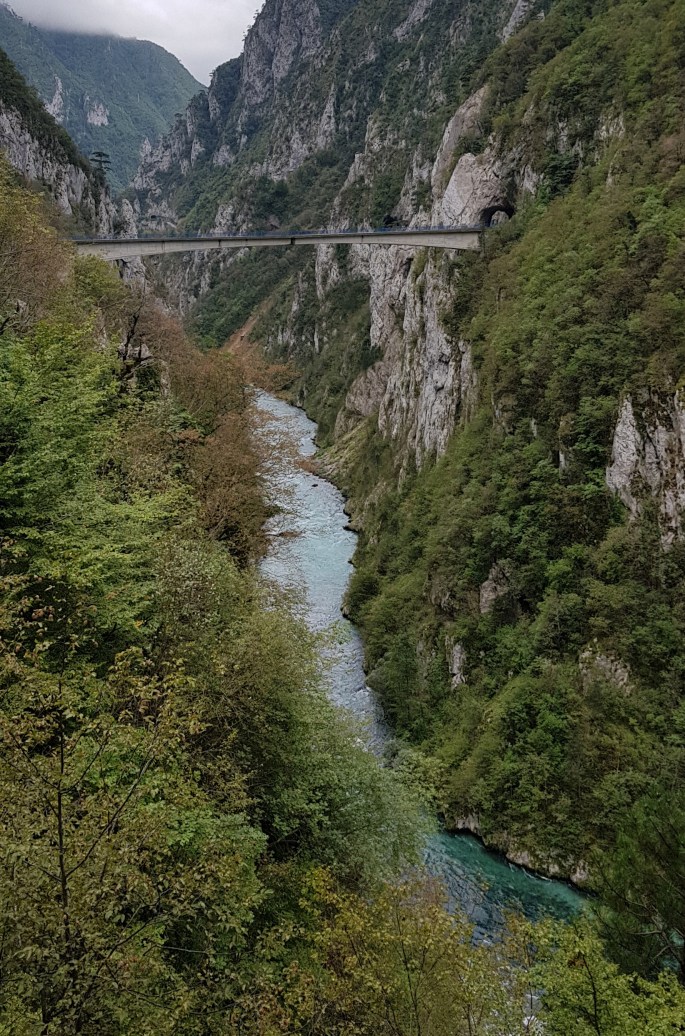
My route continues to slope gradually upwards, until I find myself cycling along the walls of the narrow and steep-sided Piva Canyon. At first I have high, rocky cliffs on my left and a sheer, vertical drop to an aqua blue river on my right. Then I have to cross an exposed-looking bridge to the other side of the canyon. I’m not brilliant with heights at the best of times, but cycling onto this bridge gives me the worst feeling of vertigo. To begin with I’m a complete pussy, sticking to the middle of the road just to keep me away from the railings and the horror of having to look over the edge. Then I stop my bike halfway across, lean it against the railings and try to force myself to become (slightly) more accustomed to my surroundings. I walk towards the edge, clasp my hands tightly on the railings and peer slowly over the side. It’s a fearsome, yet beautiful sight – I’m looking straight down on a fast flowing, turquoise river that’s fully one hundred feet below me. After a while I do get a little more used to the height, but I’m still happy to get off the bridge and over to the other side. Now I have the cliff face on my right and the scary drop on my left. This makes me feel a lot better as I’m riding on the right hand side of the road and not quite so close to the chasm.

I continue pedalling up the canyon, through a series of rocky tunnels that have been bored through the cliff face. It’s only when I reach the massive Piva Dam that the road begins to level out a little. My route crosses over the top of the dam so I persuade myself to pause once again for yet more photos and stomach-churning views back down the canyon. Behind me is Piva Lake, which was created in 1975 by damming the Drina River, and is now the second largest lake in Montenegro. I can see where the high water level would be if the dam was full, but the current summertime level looks to be about five metres below that.

Although I’ve now left the canyon, there are still dozens of tunnels to cycle through. The shorter ones are easy as they let in enough natural light to illuminate them, but the longer ones are unlit and pose more of a problem. My rear light is useless as it’s obscured by all the gear on the back of my bike, and my front torch is hiding somewhere in my panniers. I know I could stop and look for it, but in the end I just can’t be bothered. This laziness leads to the strange scenario of me riding through some tunnels in almost total darkness. On occasion I’ll have the lights of a passing car to help me, but otherwise I simply aim for the middle of the road and take my chances. This method involves a lot of guesswork, and I seem to be drawn to bumps and potholes like a magnet as I cruise along blindly in the dark. It’s a surreal sensation, like one of those sensory deprivation tanks, as I have no point of reference to tell me that I’m actually moving.

I notice that a clever car mechanic has painted his phone number at the entrance to each tunnel and also numbered them. This way if someone breaks down they can call him and tell him exactly where they are. There are a total of fifty-six tunnels between the border and Pluzine, my destination for today. By the time I reach town a fresh breeze has picked up, to the point where I feel a little cold for the first time in two months.

I check into Guesthouse Zvono, which is quite a funky establishment with views over Piva Lake. My accommodation is at the lower end of their sloping garden, which unfortunately means I have to transport my bike and gear down in installments. It’s worth it though, as I’m shown to a large, clean room set in the middle of a colourful pear orchard. The Wi-Fi in my room is practically non-existent, so I have to wander up to the guesthouse restaurant where their Wi-Fi is excellent. It’s the perfect ruse to get customers into the restaurant. Normally I don’t mind falling for this, and I’m quite happy to sit with a meal or drink while I catch up with things. This place is comfortable too, with welcoming, friendly staff. The only downside for me is that it plays nothing but jazz. The marmite of music. Constantly. At first I sit there, attempting to be as open-minded as I can, and trying to treat the sounds as if they were just background music. But it’s no use. Bit by bit, the jangly, grating randomness starts to seep into my consciousness and soon it becomes downright annoying. It sounds like five different musicians playing five different songs at the same time.

I decide to stay an extra day in Pluzine, as it’s a beautiful setting and the guesthouse has a nice feel to it, despite the jazz. I’ve also managed to give myself some breathing space with the number of days I have left to finish the trip. In Poland and Lithuania I took very few days off, putting in some big distances, and now I’m reaping the reward for that effort. With around 500km to cycle in my final two weeks, I’m looking forward to some shorter, easy rides and a few extra days off. Well, that’s the plan anyway …


Sarajevo

24th AUGUST 2018

My day off in Sarajevo begins with breakfast at the hotel. It’s a pretty standard fare, served by the owner and two staff who are smoking like fiends. For me, it still seems wrong to see staff smoking cigarettes in a restaurant, but I have to accept that it’s just the way things are here. I’m given the choice of tea or coffee to drink, and also asked if I’d like my eggs to come scrambled or as an omelette. I opt for scrambled eggs and tea, but five minutes later I’m left bemused as an omelette and a strong Bosnian coffee arrive.

It’s a steep, ten minute walk down narrow streets and into the city for the free walking tour. Our meeting point is on the steps of the National Theatre, and by the time we’re ready to begin there must be around twenty people waiting. We’re led by a guy called Neno, who must be in his mid-thirties and has lived in the city all his life.

He starts by giving us a potted history of Sarajevo, telling us the different rulers and cultural influences that have made it the place we know today. It was founded as a city around five hundred years ago by invading Turks from the Ottoman Empire, which brought ‘Islam and cool Turkish food,’ as well as mosques and marketplaces. Then the Austro-Hungarian Empire took over for forty years between 1878-1918. This was a productive time, with the city being modernised and developed by it’s new rulers. Despite the short timeframe, many of the city’s most important buildings were constructed during those forty years. The First World War ended in 1918, along with the Austro-Hungarian Empire, and Sarajevo now became part of Yugoslavia. The Second World War then saw Yugoslavia go from being a monarchy to a communist state, until the country broke up in the early 1990’s. This led to the Bosnian War, during which Sarajevo was surrounded by Serb forces and bombarded for almost four years. This siege is the longest endured by any capital city in the history of modern warfare.

Neno tells us he was seven years old at the beginning of the Bosnian War, and lived under the siege till he was eleven. The Serb army positioned themselves in the surrounding hills, then cut off all water, heating and electricity and began bombing the city. His home was on the eighth floor of an apartment block, but that was too exposed to shelling and sniper fire, so all the residents had to live in the basement to stay safe. They still had school classes in the basement however, taught by a teacher who would come to give them lessons despite the risk of being shot by snipers. He said people tried to carry on with their daily routines as best they could, as this illusion of normality helped to stop them living in fear. It’s almost unimaginable to think someone spent four years of their childhood living under those conditions. He talks about those days in a remarkably rational manner now, and doesn’t show any signs of bitterness over what happened. He says it’s the only way that things can move on.

One of our first stops is at a structure that Neno describes as ‘the ugliest building in Sarajevo.’ It was used to house athletes when the 1984 Winter Olympics were held in the city, but the drab communist-style block wasn’t considered welcoming enough. To remedy this, the organisers decided to paint the accommodation in gaudy yellows, purples, and greens. I actually think it looks quite cool, despite the awful colours.

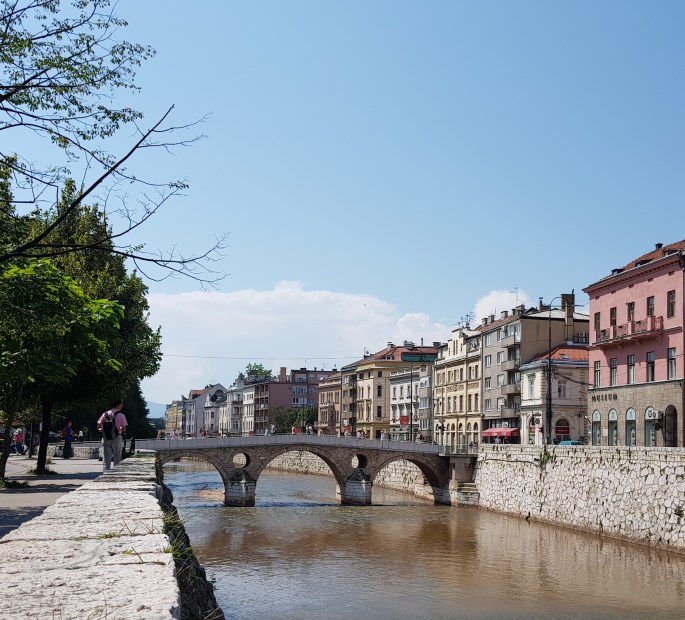
We carry on walking beside the shallow, slow moving Miljacka River towards the Latin Bridge and the spot where Franz Ferdinand was assassinated. The Austro-Hungarian Archduke had been visiting the city with his wife, but both were shot dead by a young Yugoslav nationalist. The aftermath of the killing caused a series of events, eventually leading to Austria-Hungary declaring war on Serbia. Then the allies of both countries took sides and started declaring war on each other too. Before long World War One was underway, and all as a result of a shooting in Sarajevo. The assassin’s cause was to see the end of Austro-Hungarian rule and for the Slavic states to unite together and form Yugoslavia. All this did come to pass at the end of World War One, but the killer contracted tuberculosis in prison and never lived to see the outcomes that his shooting had led to.

Then, gloriously, it’s on to the Sarajevo Brewery which has been producing beer since 1864. Beer was still being brewed here while the city was under siege during the Bosnian War, although only in small amounts. What made the brewery so important during the siege was it’s location above a source of fresh water, which it then made available to all the city’s residents. However, being a water source also made it a target. The building was almost destroyed, suffering hundreds of grenade hits and many Sarajevans were killed while waiting in line for fresh water.

We pass a few more historical buildings before the tour finishes in the Old Town. It’s bustling like an Arab market and full of tourists, but Neno says it’s still the best place to go for authentic Bosnian food. It has mosques, small family-run blacksmiths, restaurants, and souvenir shops all connected by a series of cobbled streets and narrow alleyways. There’s a tall clock tower, whose hands tell the amount of time until sunset rather than the correct time. This is handy for fasting Muslims in the month of Ramadan as they aren’t supposed to eat anything during daylight hours. Because sunset time changes daily, there’s an old man who manually resets the clock every day to coincide with this. Most tourists (and some locals) don’t know this story and simply think that the clock is telling the wrong time.

Although the walking tour is free it operates on a ‘Tips Only’ basis, and Neno does very well in this regard. By the look of things he has made more money in tips than he would have by charging for the tour. Fair play to him though, as Sarajevo’s unemployment figure is huge and yet he has found a clever and innovative way to carry on. His story of resilience is almost like a metaphor for the city itself.

After the tour ends we all walk off in our separate directions. I try to get off the main touristy streets and head up a side alley in search of some ćevapi to eat. This is a traditional Bosnian favourite that consists of about ten sausage-like kebabs, served in pitta bread along with diced onion and soft cheese. It is deliciously tasty, although probably not very good for you. Neno from the tour said he would only eat ćevapi once every couple of weeks as a treat because it is so unhealthy. Then I walk the tour again in reverse to get some more pictures, before dragging my ćevapi-filled belly back up the horribly steep hill to my hotel. What took ten minutes on the way down takes about twenty-five on the way back. By the time I reach my room I can feel sweat that is literally running down my sides, so jump straight in the shower. That evening I decide to spend an extra day in Sarajevo, as I think it’s a most excellent spot and have grown to rather like it.

For my Day Two breakfast I repeat my request for tea and scrambled again. This time I get tea and an omelette-like scrambled egg which still isn’t right but at least they’re getting closer. On the upside I do get to try the delights of putting EuroSpread on my bread this morning. It’s served in a small sachet similar to jam, but contains a two tone mixture of chocolate spread and hazelnut spread. My God it’s sweet.

I’d patched up my spare inner tubes yesterday, but they had both deflated again by this morning, so I decide just to head into town and buy a couple of new ones. I’m down the steep slope and back into the city in no time, only to find that the bike shop is closed on Saturday afternoon and will be closed again on Sunday. Bollocks. To cheer myself up I wander back to the Old Town and treat myself to another ćevapi. After Neno saying he will only eat it once every two weeks, I’m having two in two days. The remainder of the afternoon is spent pottering round the Old Town and trying to walk off the ćevapi, before I have to face that awful climb back up to the hotel once again. On the way I pass a residential building that looks like it’s still pock-marked by the holes and scars made by mortar shells. This gets me thinking about how well the city has recovered after almost four years of being blasted during the Bosnian War. The city looks so clean and modern that it’s difficult to imagine the horrors it witnessed in the early 1990’s. Perhaps this building has remained unrepaired to serve as a reminder of the siege.

In the evening I decide I better do something about my inner tubes, as I’ll not be able to buy spares any time soon. I pump both tubes up and slowly rotate them beside my ear in an attempt to hear the slight hiss, or feel the gentle breeze, of escaping air. However, there’s no obvious signs of a leak anywhere, which probably explains why they took all night to deflate. A slow puncture. With all the weight on the back of my bike though, they would clearly deflate a lot more quickly on the road. In the end I take to filling a small plastic bin in my room with water, submerging the inner tubes bit by bit and watching for escaping bubbles. Sure enough, when I reach the patch I put on yesterday, I see a tiny column of bubbles escaping from one side of the patch. I put four more patches around the offending area just to make sure. So one tube is fixed, but the second one with the dodgy valve remains a mystery. Even underwater there was no trace of escaping air bubbles, and it did take 7km of slow uphill for it to deflate the other day, so who knows ?

I’m in bed quite early tonight to rest and prepare for the final 650km push to Sarandë in Albania. Unfortunately, I’ve just found an app that shows me elevation graphs and can tell me how much climbing I’ll have between here and the Mediterranean. I think in hindsight I’d rather that I didn’t know.


Punctures and Landmines

23rd AUGUST 2018

I was late dropping off to sleep last night due to some appalling singing and loud music from a party downstairs. Traditional Bosnian tunes backed by a techno drum beat proved to be a distressing mix and it was clearly the wrong combination for sleep. I really should pay more attention to the reviews for cheap £12 a night hotels in future.

Kladanj sits in a steep sided valley, so I have to engage climbing mode straight away when I leave town. It’s hot this morning too, so apart from hills, I have the stinging annoyance of sweat running down my forehead and into my eyes. There’s so much sweat that some gets under my contact lenses and I’m constantly blinking to remove it. My eyes feel like I’ve been rubbing them while chopping onions. This section of road continues to inch steadily upwards for a total of 8km. At one point I have a steep drop to my left and a rocky cliff face rising to my right. The cliff has been in direct sunlight all morning, and cycling past I can feel it’s stored heat radiating back at me like the blast from a sauna.

A nine hundred metre long tunnel then takes me through the top part of the mountain, before a speedy downhill cancels out my 8km of climbing in no time. On the descent I’m faced with a deep pothole in the middle of the road, but I’m travelling so quickly that I can’t safely swerve to avoid it. I just grip the handlebars tightly and crunch through the middle of it, jarring me and the bike horribly. This downhill takes me right into the town of Olovo which, like Kladanj, is situated in a valley surrounded by steep hills. And just like Kladanj, I’ll need to climb another big hill to get back out of town.

Once I’m through town I stop in the shade, drink some water and prepare myself for another plodding uphill. What I’m not prepared for is a flat back tyre within fifty metres. Bugger. That was definitely a result of crashing over the pothole earlier. There’s nowhere suitable at the roadside to change the inner tube, so I push the bike into someone’s garden until I’m under a shady tree next to their shed. It takes a little while to unload the bike, get the tyre off and change tubes, so I’m happy that there’s no angry dogs or householders on the premises. My replacement inner tubes both have patches from being repaired three weeks ago, so I choose one and resume my climb. After a few hot, sweaty minutes I’m at vantage point that gives me a great view back down over Olovo, looking like a Swiss Alp legoland below me.

The road just keeps on climbing through forest and past a small cafe that barbeques chickens at the roadside. I’m only 7km from Olovo when I start to feel that weird sensation that tells me my replacement inner tube is also now slowly deflating. What is it with me always getting two punctures on the same day ? This time I pull off onto a little side road, find a shady tree and go through the whole process of changing inner tubes again. In hindsight, choosing the tube with a patch right next to the valve probably wasn’t the smartest move. The valve is always a weak point on inner tubes and it would be far more prone to re-puncturing there. A couple of locals slow down to see if I need help, which is good of them, but I just give them the Thumbs Up sign to tell them I’m OK. I’ve no more spare inner tubes now without resorting to glue and patches, so I’m hoping I make it to Sarajevo without suffering a third flat tyre today.

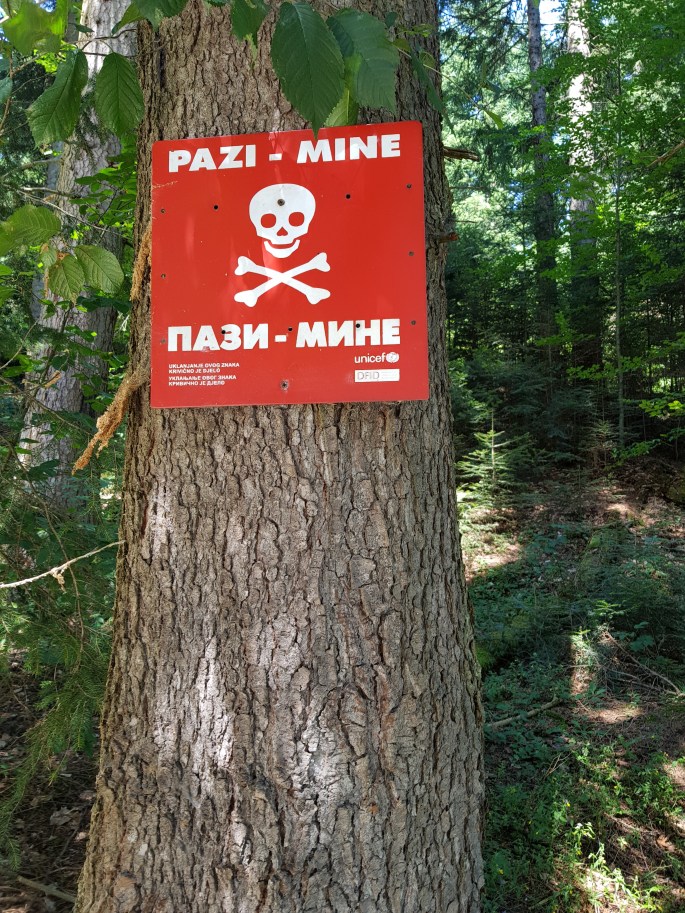
I carry on gingerly, feeling paranoid about my back tyre deflating again and continuing ever upwards. I’m close to the summit of a high pass when I notice a red sign nailed onto a tree trunk near the roadside, warning that there are still unexploded mines in these forests. They are a remnant of the Bosnian War that haven’t been cleared due to the thickness of the forest and it’s vegetation. Normally I try to get right off the road when I stop to eat, but I think it’s probably wise to shelve that tactic while I’m in Bosnia. I later find out that more than 500 people have died as a result of uncleared landmines since the war ended in 1995.

I’ve been working really hard and sweating my arse off on this hot ascent, climbing solidly for the 15km since Olovo. So much for the cleaner’s advice yesterday that it was all downhill after Kladanj ! However, the next 20km are indeed all downhill and I’m about to drop around five hundred metres in altitude between here and Sarajevo. Even when the road seems to level out, I know that I’m still losing height as I’m following a river downstream.

One thing I’ve noticed is that Bosnia is the first country on the trip where drivers will toot at me for no apparent reason or seemingly just for fun. In Scandinavia the drivers were so polite and law-abiding that they rarely ever needed a car horn, but as I’ve cycled further South the horn use has increased dramatically. Sometimes a driver will sound their horn when approaching from behind just to let you know they will be passing you, but in Bosnia many seem to toot or wave just for the sake of it. Maybe they do it to encourage me when I’m climbing hills, but I find it a nice, friendly trait whatever the reason.

My freewheeling lasts until a river valley, before I arc round a mountainside for my final 15km into Sarajevo. The city seems to have been squashed into a thin area between the surrounding mountains, which gives the route into town a busy, bustling feel. The roads are so narrow though, that there’s barely enough space for two lanes of traffic, without me adding to the mix with a bulky bicycle. When the traffic gets too heavy I take to cycling on the pavement for a while, but I’m having to be extra careful with my tyres on the uneven surfaces. I pick my way along the mountainside, through a few more kilometres of traffic, potholes and pedestrians until I find the street where I’m staying tonight. Unfortunately this road has a sharp little climb with the nastiest gradient I’ve seen for a while. It’s looks so intimidating that I think I’ll have to get off and push, but I surprise myself by reaching the top fairly easily. Two and a half months of pumping pedals have made my legs skinny, but stronger than I thought !

I’m staying in an old, three-storey hotel that appears to be firmly placed in the category of ‘faded grandeur.’ When I go in there’s bloke sitting behind the bar, who also doubles as reception, casually puffing away on a cigarette. I think it will be a long while before any Smoking Ban hits the Balkans. My bike is left in the bar, resting against some bar stools and I’m assured that it doesn’t even need to be locked as ‘Is OK here. I look after.’ Then to my dismay, I find that my room is on the third floor, which is a bit of a cruel joke on my thighs after all the hills and climbing today. I’m taking a Rest Day tomorrow and have booked myself onto a free walking tour of the city, even though I normally prefer to wander round towns and explore on my own. However, on this occasion I don’t mind being guided round the city, as I feel that Sarajevo will have many stories to tell.


Coffee, Alcohol and Bingo

21st AUGUST 2018

It’s not every day I can write ‘I woke up at the Distillery,’ but today is that glorious day. Breakfast is part of the deal here, so I head over to the restaurant and find I’m the only customer in a cavernous space with high ceilings and a huge bar that runs almost the length of the room. The bloke behind the bar brings me over some tea and orange juice, then asks if I’d like to try some of the distillery’s own Rakija while I’m waiting for breakfast. Rakija is a fruit brandy, popular in the Balkans, and similar to the Palinka I had in Hungary. So, apart from a tiny sip of orange juice, the first thing I will consume today is a huge measure of quince brandy.

The barman disappears upstairs and returns from the kitchen with a gorgeous looking fresh breakfast and the offer of yet more Rakija. I’m served a gourmet taste plate packed with omelette, cottage cheese, ham, pate, bread, yoghurt, tomato and bacon. While I’m eating, the barman tells me that he is still recovering from a minor stroke he suffered about nine months ago. As a result he now can’t feel hot or cold on his left hand unless the temperatures are really extreme. He also can’t have fizzy drinks or sweets again as he’s been warned they may trigger another stroke. He’s quite philosophical about it all, and takes the view that every day is now a bonus and that he was lucky to survive. He’s only in his mid-thirties.

I’m shown the downstairs cellar, full of date-stamped wooden barrels that will sit maturing for years and decline my third shot of breakfast Rakija. The barman, who has been an absolute star this morning, gives me a handful of apples straight from their orchard to send me on my way.

To begin, I have to retrace yesterday’s cycle back towards Gradačac and pass a huge sign telling me that I am now leaving the Republic of Srpska. I had seen this sign on the way here, but had no idea what it meant. The barman filled me in that the Republic of Srpska is an autonomous region run by Serbs within the borders of Bosnia and Herzegovina. My limited understanding of this situation is that there are now essentially two separate countries within Bosnia and Herzegovina – one for Serbs and one for Bosniaks. To me it seems sad that the country is still so obviously divided along religious and ethnic lines a full twenty-three years after the Bosnian War ended. However, a more optimistic view would be that it’s almost a miracle the two sides now manage to live side by side after the horrors and hatred of that war.

It seems the Republic of Srpska comprises mostly the North and East of the country, which are basically the borders with Serbia and Croatia. The Federation of Bosnia and Herzegovina has Sarajevo and the West. I do notice that mosques become far more common once I leave the Republic. They all seem very modern, with minarets that look like a tall, slim rocket standing beside a normal building. It takes me a little while to work out that they’re all modern because the old ones would have been destroyed during the war.

The hill I have to climb to get out of Gradačac is ridiculously steep, and my morning intake of Rakija certainly isn’t helping me reach the top. As I lumber up the slope I see a digital sign at a petrol station which tells me the temperature has already hit thirty-six degrees celsius. I manage to gasp ‘No Way!’ out loud as I pass. There is a horrible chance the sign may well be correct, though, with the amount of sweat that is dripping through my eyebrows and into my eyes. When I reach the summit I have to stop and stand under an apple tree for a few minutes feeling dazed and trying to get my breath back. Mercifully, I’m rewarded with a long, steady downhill from the summit, so I just freewheel and enjoy the cooling effect of the airflow that has been created.

I’m only covering 60km today, but it takes a lot longer than it should due to a combination of hills, heat and a messy route that involves a few too many junctions. I think I spend as much time resting under shady trees as I do cycling, but I still reach Bosnia’s third largest city of Tuzla by mid-afternoon. My accommodation is run by a thirty-something guy who looks like he has inherited his grandmother’s house and converted it into a guesthouse. Within two minutes of our meeting, he tells me that he hates speaking English and that all Bosnians feel the same way. Charming. He also tells me that today is a Muslim holiday, so there will be nothing open in town. As a result of this my dinner consists of the nuts, bananas and chocolate left over from today’s cycle.

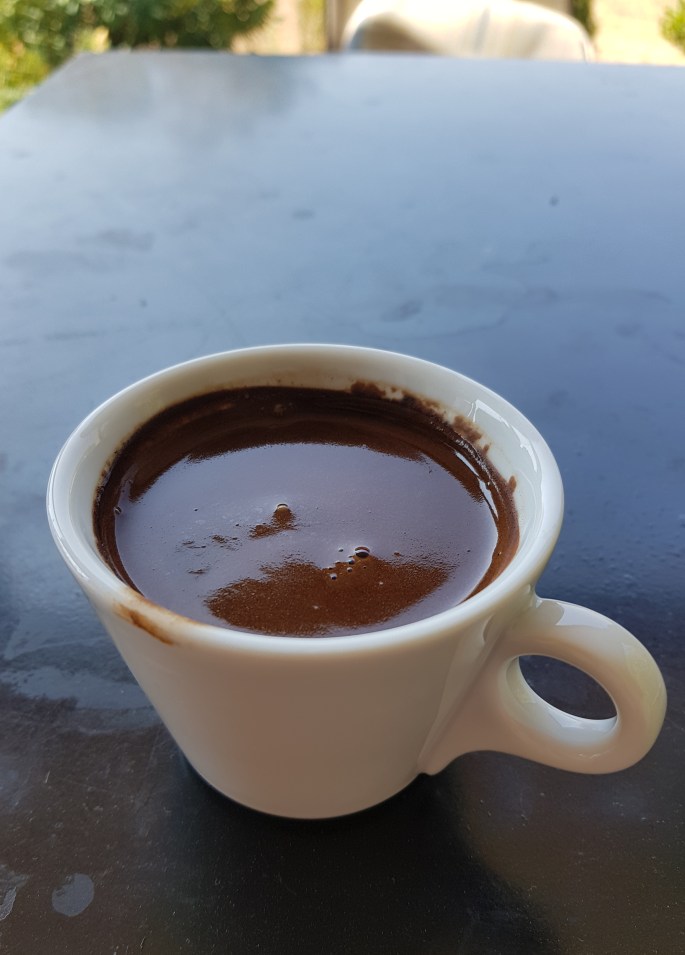
I’m up early the following morning and walk to a small supermarket for breakfast and road food. Keny, the guesthouse owner is in better form today and asks if I would like a coffee before I go, so I sit at an outside table with him and an old bloke who does the cleaning. I’m not really a coffee drinker, but Bosnia is famous for its coffee, and I do like to try the local food and drinks if I can. It takes about five minutes to make from fresh, hand ground coffee beans and is served in one of those tiny little espresso cups. Weirdly, even though it has a strong flavour, it doesn’t really look or taste like coffee as I know it. When I reach the bottom of the cup it has the consistency and colour of grainy melted chocolate. By this point the coffee is so strong and bitter that I can almost feel my lips pursing and eyes widening as I drain the last mouthful. I imagine that I look like one of those kids you see on You’ve Been Framed who get fed a lemon just so their parents can laugh at their expressions.

Keny seems to have warmed to me more now that he’s discovered I’m from Scotland. He has a discussion in Bosnian with his cleaner, who sounds like he is trying to explain the difference between me being ‘Scotski’ and plain old ‘Britanci.’ He then tells me that Braveheart is a beautiful film and shows me a picture on his phone of a guy who caused a stir by wearing a kilt on his night out in Tuzla. After a while Keny departs to drive another guest to the train station, while his cleaner gives me some advice for the road ahead. According to him I should expect 50km of uphill as far as Kladanj, then 70km of downhill to Sarajevo. However, experience has told me to take almost all well-meaning road advice with a pinch of salt.

The road out of Tuzla follows a river downstream, then passes an ugly thermal power plant that is belching smoke from four tall, fat chimneys. A steep short cut then takes me above the power plant, and I begin a slow trudge further upwards. As I’m plodding along I start to hear the most awful squeaking noise, which sounds like it could be coming from my pedals or the pannier rack. It’s only when I stop to take a look that I realise where the horrible racket is coming from. I’m being followed by a mad old guy on a squeaky bike and the noise is coming from him, not me. He’s grinning at me like a loon and trying to communicate, but we are getting nowhere. I tell him I’m heading for Sarajevo, so he pulls ahead to show me which way to go. All the time he’s turning round to talk to me, which leads to him swerving dangerously all over the road like a drunkard. Perhaps he’s been on the breakfast Rakija too. I’d feel terrible if he got knocked over, so I’m bloody relieved when he wobbles off the road and into his workplace.

The road is fairly flat for the next 15km, but all that changes after the biggish town of Zivinice Grad. I start a gradual climb, through some poor looking villages and past lay-bys strewn with litter. In one town a teenage lad on a bike follows me for a bit and asks for money. I just laugh and tell him I have none, which he seems to accept, before he says ‘Auf Wiedersehen’ and cycles back to his friends. All this gets me thinking how easy it would be to mug a cyclist in the middle of nowhere if there were four or five lads who fancied it.

A few kilometres further along I see a dog on the opposite side of the road, but outside it’s garden fence. I don’t think the hound will cross in case it gets hit by a car, but as soon as I’m past it rushes over the road and jumps up on to a wall beside me. The wall runs for about fifty metres and the dog runs along behind me barking and snapping all the way. I can see the wall is going to end soon and provide the dog with a chance to get back down to road level, so as I’m cycling I have a look for any sticks or rocks. It’s going to get an almighty smack on the head with something very hard if it tries anything. I’m happy it doesn’t come to that, and thankfully the dog stops when the wall does. I figure this is the dog’s party piece and running along the wall and barking is what it does all the time. Still, whether I’m being chased by malevolent dogs or harassed for money by teenage lads, I’ve had a couple of reminders of how vulnerable you are on a bike.

The road continues to climb slowly, before rising sharply for the final 10km to the summit. It’s probably five degrees cooler than yesterday, but I’m still plagued by sweat trickling into in my eyes and dripping off my nose as usual. At the top I can see bare mountains in the distance, while below there’s a green valley dotted with light-coloured buildings topped by terracotta tiles. In fact I’m surprised that the surroundings look so lush and green, given the recent high temperatures and lack of summer rain.

A speedy downhill then takes me into Kladanj, which wouldn’t look out of place in the Swiss Alps with ski resorts and chalets clinging to the surrounding hills. I’m staying at the very un-Swiss Hotel Bosna though, which is primarily a bar and club that also happens to rent out rooms. The bar staff look surprised and inconvenienced by my arrival, but at least they manage to find me some accommodation. One guy shows me to my room and I ask him where I can put my bike. He just shrugs and motions to the landing outside, clearly demonstrating that he doesn’t give two shits where my bike goes. I reciprocate by not giving two shits about his hotel and dragging my dirty bike upstairs and into my room.

In the evening I go and do some shopping in a complex that has a large sign above it saying ‘Bingo.’ For my first couple of days in the country I thought that Bosnians must be obsessed with the game as there seems to be Bingo Halls everywhere. It’s taken me this long to realise that it’s actually the name of a supermarket chain !


Feeling Slightly Woozy

18th AUGUST 2018

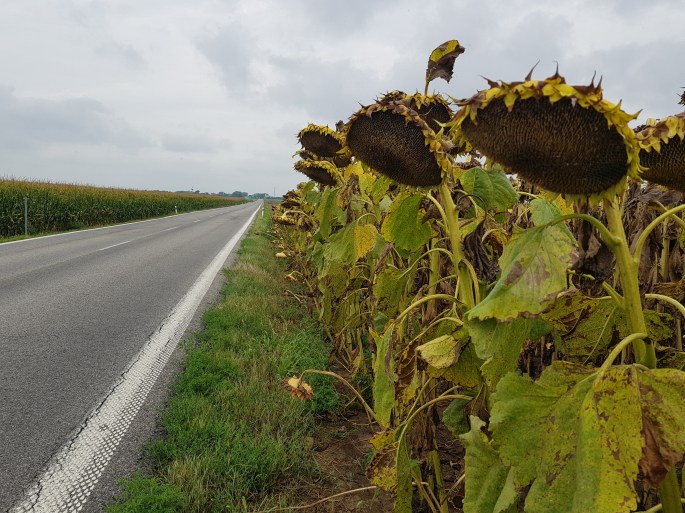
I leave the guesthouse in Beli Manastir at my own leisurely pace as I’m the final customer to depart and don’t have any check-out time to worry about. I post my keys back through the letterbox as I go, then coast downhill to join the flat, straight road that will take me out of town. This road is so gunbarrel straight for the first 10km that I’m quite excited by the prospect of an upcoming bend, only to get round it and find another 10km of dead straight asphalt stretching off into the distance. Heat slowly builds on this flat plain and the road continues without deviating until I cross the Drava River and by-pass the city of Osijek.

A sign tells me that it’s now only 25km to my destination of Đakovo, but at this point I start to feel a little woozy and lethargic. I struggle badly with this remaining distance and stop a number of times to shelter in the shade or to take on water. I’ve got a headache and my eyes are feeling over-sensitive to the bright sunshine, which I know is not a good sign. I crawl into Đakovo, feeling drained and shitty, about 3.00pm.

I check in to the Laguna Restaurant, which has rooms upstairs and a wedding reception in full flow downstairs. My bike goes into a second reception room, which I am assured will be locked overnight, but at this precise moment I really couldn’t care less. I just need to lie down. I go upstairs, have a shower and then crash out on top of the bed for nearly two hours. I barely move for the rest of the evening and am left wondering why I feel so rubbish. I’m hoping that I’m simply over-tired from all the days spent cycling in mid-thirties heat. However, it could just as easily be some form of illness, heat-stroke or something that I’ve eaten. It may even be a legacy of all that home-made Hungarian palinka. Tomorrow will need to be a Rest Day.

When I wake the following morning I still don’t feel great but, predictably, I still manage to make it downstairs for breakfast. The buffet on offer involves a pretty standard fare of eggs, bread, ham, cheese, yoghurt and pate. There’s no tea or juice, but an unlimited supply of watery coffee. With a full belly, I plod back upstairs and promptly fall asleep under the air-conditioning. I really don’t move much all day except to keep myself hydrated and to nibble on road-food leftovers. Spending a lazy day indoors, away from the heat and sunshine is just what I needed, and by late afternoon I’m starting to feel much better.

In fact I’m feeling so much better that I don’t mind suffering a humid thirty-three degrees and a walk to the large Spar supermarket in town. When I step out of the accommodation I’m a little bewildered to find one of my cycling gloves lying on the road outside. It must have fallen when I took it off at check-in yesterday, and then lain there in the same spot for over twenty-four hours. As I walk past I simply pick it up and put it back in my pocket. At first I think my find is an incredible stroke of good luck, but in reality no-one was ever going to claim such a disgusting looking single glove. I’ve actually taken to not wearing my gloves for the first hour of every cycle in an attempt to even up my ridiculous tan lines. At the moment my forearms are coloured an outdoorsy brown, whereas the back of my hands are still office-worker white. It looks as though my hands and arms belong to two different people and have been fused together à la Dr Frankenstein.

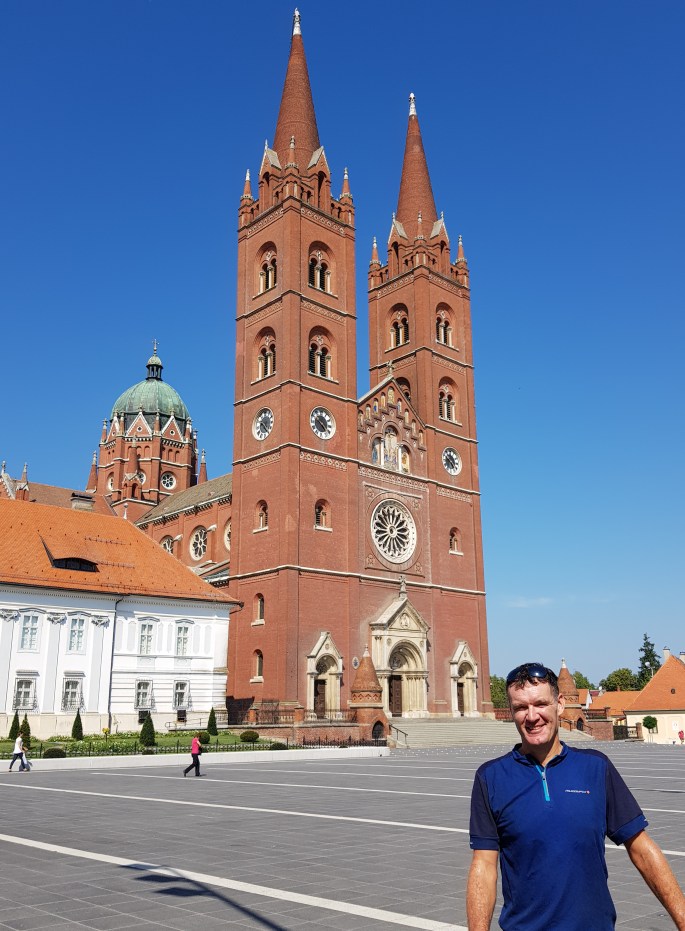
The following morning I feel like I’m just about back to normal, and head downstairs to stuff myself with enough breakfast to keep my legs spinning all day. As I leave town I make for the main square to get a look at the impressive Đakovo Cathedral. It’s quite a sight with red brick double spires contrasting against a deep blue sky. Apparently it took only four years to build, but a further eight years to decorate the insides. I stop three different locals to ask if they can take my photo in front of it, and all three manage to chop the top of the spires out of their pictures. With the next person I resort to some furious miming to make sure they keep the spires in shot. Thankfully they do.

I’m heading into Bosnia today, and want to cross the border at a town called Šamac. I get to within a few kilometres, only to find a roadsign telling me that the road ahead is closed. There is a diversion in place, but that is sending traffic off towards a motorway which, of course, is out of bounds for cyclists. Bollocks. I spend a while on Google Maps and find a route through the countryside that looks like it will bring me back out at Šamac. A handful of quiet villages line these roads, where many houses have wooden shutters over their windows, closed to block out the fierce afternoon heat. I end up travelling an extra 20km, and all the while I’m hoping that the closed road is not at the border crossing bridge.

The Sava River forms a natural border between Croatia and Bosnia and there’s only a limited number of crossing points. That means if the Šamac crossing is closed, I’ll be facing a lengthy detour just to reach the next bridge crossing. Luckily though, my detour has taken me past the road closure and brings me in to Šamac through the back of town. I find the Croatian border post on the north side of the river, while the Bosnian border post is on the south. The bridge is a kind of No Man’s Land in between. Once again I have to queue with cars to get through but, once again, both exit and entry are a formality. The Bosnian border guard stamps my passport to say that I arrived via Šamac, but a little logo on the stamp also says that I arrived by car. I’m guessing they don’t have a logo for arrival by bike.

I’m able to visit an ATM just after the border and withdraw some local currency, in the form of Bosnian Convertible Marks. This currency was pegged to the German Mark in 1995, but now that Germany uses the Euro I’m not quite sure how it works. I’m just grateful to get some money so soon after crossing the border.

My accommodation for tonight is past the town of Gradačac, in a distillery that is supposedly owned by one of the richest families in Bosnia. I’d already planned a route that would take me there on quiet country roads, thus allowing me to avoid the town. However, the first road turns out to be nothing more than a dirt track, so I stick to the main road, follow tourist signs for the distillery and have to cycle through the bustling Gradačac anyway. About ten minutes later I’m in the middle of nowhere and find the distillery in a peaceful rural setting, fronted by pear and apple trees upon manicured lawns. The reception has closed and there doesn’t seem to be anyone around, until I’m approached by a bloke on an old battered bike. It turns out he’s the owner, and it warms my heart to see him gadding about on such an ancient piece of junk despite his obvious wealth.

I get the impression that the accommodation is almost a sideline for their business, with the distillery, restaurant and conference venue being the main focus. It’s maybe due to this that it’s so reasonably priced, but for me it’s still a luxury. I lie under air-conditioning on my comfiest bed of the trip so far and reflect on the strange nature of the last few days. I’m glad I was able to complete today’s cycle without any problems, which is a huge relief after feeling so crappy two days ago. I still have no idea why I felt so bad, but I’m getting back to full strength just in time. I know that things are going to get hotter and hillier from this point onwards.


Into Croatia

16th AUGUST 2018

I’m all ready to go again and feeling almost refreshed after my lazy Rest Day in Dunaföldvár. The only physical weirdness I have is a chubby, swollen finger as a result of a mosquito bite. It takes me back to something I was told by a guy in Finland – he reasoned that there are many different types of mosquito and only certain ones will cause a reaction until you get used to them. I thought he may have been talking nonsense at first, but now I’m not so sure. Mosquitos in the north of Finland were huge, ravenous and descended within seconds, whereas Hungary’s are tiny and flit around teasing you for ages before they decide to bite. It seems strange that it’s the smaller ones who have caused a reaction.

I check out of my funky pottery accommodation and have to cross the Danube River for the second time as I leave town. After a few kilometres I’m able to join the Euro Velo 6 cycle path as it runs alongside the road for a while. This route begins on the Atlantic coast of France and runs for 3,650km all the way to the Black Sea in Romania, passing through ten countries on its journey. I could simply follow this track all the way down the Danube and into Croatia if I wanted to. However, it has an annoying habit of degenerating into a dirt track or meandering through fields, which means I usually just stick to the road. For now though I’m happy to tag along as this section is so gorgeously smooth and well kept it’s like cycling on a marble floor. I even have a tailwind, so I’m on course to get to my Warm Showers hosts way ahead of our 5.00pm meeting time. I don’t want a long wait outside their house, so stop in a village called Dusnok and find a riverside park with a shady tree to sit under.

Ironically, after not wanting to arrive early, I miscalculate how long it will take cycling to Baja and arrive an hour late. My host is a man called Roland who has just moved into a large modern bungalow with security gates in a brand new housing development. He’s cooking when I arrive and offers me a shot of palinka fruit brandy as a welcome greeting. I say ‘a shot’ but it’s probably closer to half a glass. This particular one has been home-made by his father-in-law so there’s no telling what the alcohol percentage is. My God it is strong ! I can feel a warming sensation in my throat afterwards as if I’ve just eaten chillies. Roland seems to be channelling Keith Floyd while he’s cooking and pours a second palinka as soon as we’ve finished the first. I’m going to end up trashed on an empty stomach if we continue at this pace !

In between mouthfulls of palinka, he fries some meat cubes and veggies in two separate frying pans, before breaking six eggs into each pan. The process looks similar to cooking an omelette, but the eggs haven’t been beaten and just cook slowly amongst the meat and vegetables. He tells me most Hungarian recipies call for lashings of paprika and proceeds to sprinkle handful upon handful of the red spice into each pan. The dish is then served along with a hearty feast of bread, chorizo, salami, peppers and cherry tomatoes. It tastes deliciously fresh and I attempt the difficult task of trying not to look greedy while at the same time eating like a horse.

We eat at a long dining table along with his wife and five children, who gabble away in Hungarian while Roland speaks to me in English. Not for the first time I find myself wondering why someone would act as a host and what they get out of it. For Roland it is simply a case of wanting his kids to grow up seeing as many different people and cultures as they can, which is really refreshing in this age of nationalism and xenophobia. What marks him as unusual amongst Warm Showers hosts is that he’s not a cyclist himself. He says he used to host couchsurfers but gave that up as he felt most of them were just after a free bed for the night. Now, I’m not about to get all righteous here and pretend that I don’t care about getting free accommodation. I do. It makes a huge difference on a trip like this. What I value just as much though is getting the chance to spend some quality time with a Hungarian family, chatting, sharing their food and seeing how they live. This way I feel I get a proper feel for the country and I think it’s one of the best parts about travelling.

Roland’s wife and children depart the table in dribs and drabs as they finish their meal. One of his younger children then returns to show off a hedgehog they have adopted and that is now effectively a family pet. Roland cracks open a bottle of red wine, complete with genuine cork, and we sit chatting till after midnight. A lot of his conversation tends towards the dull field of politics, which wouldn’t be my first choice of topic. All the wine and palinka in my system, coupled with the boring subject matter, means my concentration is lacking and very little information finds its way into my slow brain. I’m barely able to keep my eyes open by this point and make my way sleepily to the spare room / office where a fold-out sofa bed awaits me.

In the morning I thank my hosts for their hospitality and find that they are a ‘don’t do breakfast’ household. I cannot comprehend this as I’m a fat calorie whore when I’m on a cycle trip. Roland must recognise this as he gives me three bananas to send me on my way.

It’s about 9.00am when I set out and the temperature is already in the high twenties. There isn’t a breath of wind or a single cloud to be seen in the pale blue sky. Today already feels like it has the potential to escalate into a blazing, dry scorcher. I leave town and re-cross the Danube (again) as I need to be on the west side of the river to reach the border crossing into Croatia. The terrain starts out very flat near the river but then begins to climb gradually. I’m soon up a slope looking at countless rows of vines that stretch back into the distance and support healthy bunches of plump, black grapes. Then it’s an easy downhill towards the village of Bár for my last look at the Danube, before a long, sweeping bypass takes me round the town of Mohács and on to the Croatian border.

So far I’ve been used to breezing through land borders without having to even think about my passport, but that is destined to change from this point onwards. There’s only a small line of about ten cars waiting to cross, which is just as well, as I have to join their queue and stand in the blistering sunshine as I wait. Fortunately, I only have to stand for fifteen minutes, but I still keep my helmet on right up until the checkpoint to remain shaded for as long as I can.

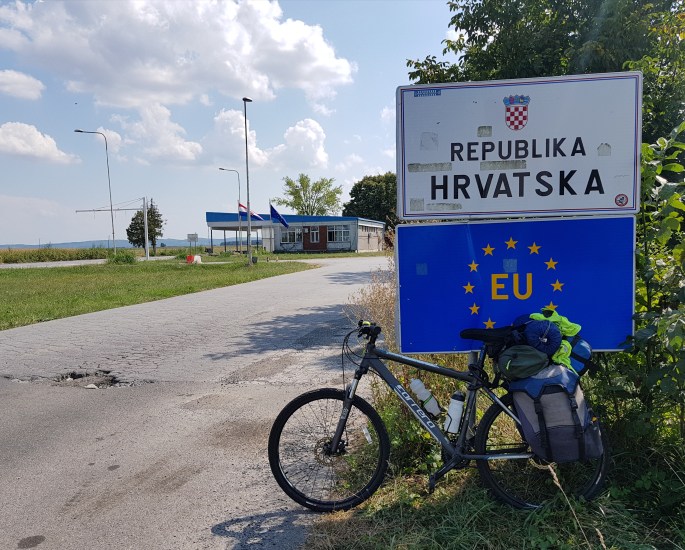
At the checkpoint the Hungarian and Croatian border officials seem to be on very good terms; a large round of hand-shaking breaks out when a new batch of officers arrive to begin their shift. When it’s my turn to cross I step forward to a booth and show my passport to what looks like a Hungarian policeman. He barely looks at it because I’m about to leave his country and, therefore, am no longer his problem. I then take two steps forward to the next booth to be greeted by a young Croatian guy who takes my passport and begins examining it. I get the impression that he doesn’t encounter many British passports at this crossing as he seems a little unsure what to make of it. He studies the front cover where it says ‘United Kingdom of Great Britain and Northern Ireland,’ but that doesn’t help him. Then he begins to flick through the inside pages to look for visa stamps, but only finds ones for Fiji and South East Asia. He looks completely flummoxed and, although he doesn’t actually shrug his shoulders, he might as well have. He just hands me back my passport with a huge smile and says ‘Goodbye !’ I push my bike into Croatia and am met by an old battered sign that reads Republika Hrvatska.

From the border it’s only 25km to my destination of Beli Manastir, which looks quite a run-down town on first impressions. I find my guesthouse but, with the aid of another tailwind, I’ve arrived about an hour earlier than I said I would be. I ring the doorbell to find no-one is home and spend forty minutes waiting on the doorstep accompanied by a faint smell of cat’s piss. The lady owner turns out to be really friendly though, and takes her time showing me around the house. She says to check-out whenever I feel like in the morning and just to leave the keys outside in the post box. On her way out she tells me ‘The house like your own.’

I walk into town to find a bank to withdraw some Croatian money and to see if there’s any truth to the story that the higher the value of banknote in Croatia, the more facial hair the person depicted on the note has. I’m disappointed to find the theory disproved as the bloke on the 200 kuna note has only a goatee, while the hairy chap on the 100 kuna note has bushy sideburns right down to his mouth. I carry on wandering through the streets to find that it is indeed quite a poor, neglected town with many derelict buildings and closed businesses. It’s almost like no-one cares about the place as a lot of cars, buildings and gardens look like they have just been abandoned. I pass a closed down cafe that looks like it has been forgotten. There’s a dead cat on the outside porch which appears to have been lying there for days. The eyes are missing and its stomach has sunk into the pavers as all the organs have started to decompose. It’s a grim spectacle.

My original plan was to head for Osijek, but I’ve decided just to carry on south tomorrow to a place called Đakovo. My passage is going to take me through the skinny, inland part of Croatia, even though I know the prettiest and most touristy parts of the country are on the Mediterranean coast. This may seem like a strange choice, but I want to try and save the Mediterranean till the end of my trip – A sort of reward for finishing the journey. With this route in mind, it looks like my stay in Croatia will only be a fleeting one.


‘Allo ‘Allo Hungary

12th AUGUST 2018

I’m leaving Slovakia today and am aiming for a town called Tata in Hungary, where a Warm Showers host has offered to accommodate me tonight. They aren’t home until 6.00pm though, so I prepare for a slow, easy 70km that will have me in my eighth country of the trip by lunchtime.

The border crossing is over the slightly murky looking Danube River which acts as a natural barrier between the two countries. The settlement on the Slovakian side of the river is called Komárno, while the one on the Hungarian side is called Komárom. Back in the days of the Austro-Hungarian empire it was all one big town that straddled the river, but now it has been cut in two by an international border. Crossing between the countries nowadays is as simple as cycling over the green iron bridge that spans the Danube. I stop halfway between the welcoming flags for each country and see that the blue ‘You Are Here’ dot on my Google Maps has been neatly halved by a line representing the border. As I leave the bridge on the Hungarian side I see an abandoned checkpoint building from when this was a manned border crossing. Today if you fancied going for lunch in Slovakia you can just walk freely across the bridge and be eating potato dumplings within minutes.

Despite cycling with no urgency at all today, I still arrive in Tata by 4.00pm, which means I have about two hours to kill before I can call on my Warm Showers hosts. As always, one of my first tasks in a new country is to find an ATM to get my grubby hands on some local currency. In Hungary this is the Forint which, at 363 Forint to the Pound, is going to be an awkward exchange rate to work out while shopping. At an Autobank I withdraw 25,000 Forint but, strangely, the machine spits out only one 20,000 note and one 5,000 note. This is the equivalent to getting a £55 note and a £15 note, which are going to be enormous fun trying to get rid of.

Riding through town I’m fortunate enough to stumble upon Lake Öreg (Old Lake) shimmering in the afternoon sunshine, and stop here to pass time. It’s a lovely spot with cafes, restaurants and an old ruined castle along one shoreline, while the remaining three quarters of lakeside is undeveloped. I relax on a bench, munch some of my road-food and watch fish jumping in the lake whilst tourists mill around aimlessly. Two hours drift past almost unnoticed.

Leaving the lake, I cycle past a white church that boasts two clocktower steeples and into a quiet suburb to find the house of József, my Warm Showers host. I’m welcomed by him and his wife, Kata, who have just returned from spending a weekend in the country. He had told me beforehand that his English wasn’t very good, but it turns out he was just being modest and can converse easily. Anything he doesn’t understand is typed straight into Google Translate so we are never stuck for more than a few seconds. His longest cycle trip to date was from Germany back to Hungary, following Euro Velo 6 and tracking along the Danube River. This trip would appeal due to its picturesque nature, but my lazy streak would also love that it’s all generally downhill in nature.

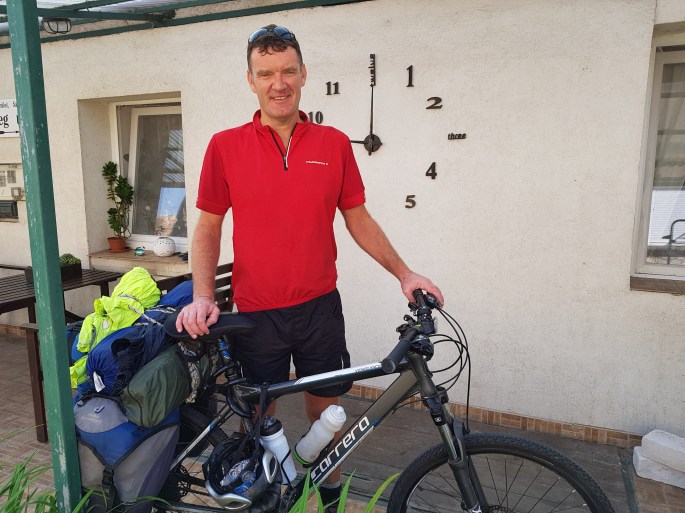
Kata’s brother visits in the evening with some ‘Bad News’ which leads to my hosts retreating into their bedroom about 9.00pm. This leaves me on their couch, where I can’t help wondering about the nature of their bad news as I settle in for the night. There is no mention of it again the following morning and I think it better not to ask. József takes a photo of me and the bike outside his house before I leave, which I think must be a little tradition he goes through with all his guests. I thank my hosts and make my way back down to the lakeside where I sit and eat breakfast, before saying Goodbye to Tata.

My target for today is the city of Székesfehérvár, which apparently translates as ‘white castle with a chair’ due to Hungarian royalty being crowned here until the 1500’s. Whatever it means I find it completely unpronounceable, giving the locals a good few chortles at my hopeless attempts. I only have to cycle 77km, but it turns into a bit of an effort battling that troublesome combination of hills and heat. It’s not until I near the city that the road begins to follow the Danube downstream and my day becomes easier.

My accommodation is in quite an affluent looking suburb where I’m given an upstairs room in a large family home that has a sliding electronic gate at it’s entrance. The bike is left outside under a tunnel-shaped trellis which is overflowing with heavy bunches of green grapes that hang temptingly at head height. I decide to try a few to make sure they aren’t poisonous. I shower, then walk to Lidl to replenish my system with fruit juice and various offerings from the chilled cabinet. I swear I’m now addicted to cold pasta and salad. At night my room is unbelievably hot and sticky, but I don’t want to open the window due to the double menace of mosquitos and traffic noise. I lie in an uncomfortable sweat for over an hour before I realise there’s an air-conditioning unit above the door. I’m so accustomed to not having air-con that I completely forgot it may be an option in some places. As soon as I feel the refreshing air-flow, I know it’s destined to remain switched on for the entire night.

In the morning I leave town by heading back towards Lidl, feeling like a local by using the same little side streets that I walked last night. I had plans to get through Hungary via the shores of the massive, touristy Lake Balaton, but that route looks like it will be expensive and busy in August. Instead, I decide to take the simple and more direct option of following the Danube River downstream. The first 50km of my ride today is spent heading towards the river, then a further 20km has me in the small riverside town of Dunaföldvár just as rain is threatening.

I’d booked myself into a room above a restaurant, but when I arrive I’m told they are fully booked. Even when I brandish my phone to show them my booking confirmation it makes no difference. They insist the company that I booked through has made a mistake, although it’s clear that they’ve just given the room to a walk-in customer rather than pay commission on my booking. This discussion goes back and forth a few times but I know it’s not going to get me anywhere, so I admit defeat and take a slow ride through town. I’m all set to make my way towards a campsite when I see a sign for the Tourist Information office and think I’ll try that first. The girl behind the desk isn’t particularly helpful, but she does give me a flyer for a guesthouse in the next street which, fortunately, turns out to be just the ticket.

I’m welcomed into the courtyard of what looks like a working pottery by a laid back, bohemian couple in their fifties. The old guy is more interested in rehydrating me with a couple of raspberry soda waters than sighting passports and other such check-in formalities, which means that I warm to them straight away. This relaxed attitude from the owners adds to the chilled, quirky ambience of the surroundings – A brick courtyard runs back from the street entrance and sports a disjointed assortment of pottery, trinkets, paintings, shells and old books for sale. This area doubles as their workshop / garden and is home to an affectionate tabby cat and a lovely fat sausage dog with the nicest temperament.

My room is low and narrow with wooden beams in the ceiling, ancient novels in a glass cabinet and a writing desk complete with quill and ink. Just inside the door there’s a wooden stand displaying an album cover by a man called Sardy Janos, who looks a bit like a Hungarian Elvis. The owner bloke tells me he was a well known writer and singer who used to live in this very room before he became famous. Goodness knows how he lived in such a small space for any length of time though. Bizarrely, there is also a bird cage hanging from the ceiling in one corner with a stuffed budgie sitting on the perch inside.

I leave the door to my room open and watch a fierce thunderstorm that lights up the sky and has rain absolutely battering off the brick pavers outside. Incongruously, this savage downpour is accompanied by the jaunty sounds of 1930’s swing music that the owners seem to favour. By evening the elements have calmed down and the only sound I can hear is from the TV in the room next to mine. I hear the theme tune to ‘Allo ‘Allo! drifting through the night and some dubbed Hungarian dialogue shortly afterwards. I have no idea what is being said but the lady owner sounds like she is just about wetting herself with laughter. Once I turn out the light I’m pestered by the awful whining sound of mosquitos, and take to spraying myself from head to toe in repellent.

I’ve just cycled fourteen out of the last fifteen days and definitely feel like I need a Rest Day. I’m also liking the feel of this oddball accommodation so I decide to spend an extra day amongst the kookiness. The only blight on the surreal tranquillity of this place is that the owner smokes like a chimney and therefore spends a large proportion of his day hacking and coughing like a consumptive.

Apart from food shopping and wandering around the town’s castle, I treat my Rest Day very literally. I do spend time sending about a dozen Couchsurfing requests in an attempt to find a host for the days ahead, but to no avail. Couchsurfing really is shit. Luckily, there is the cycling-oriented Warm Showers site – I send two requests on there and get two hosting offers almost immediately. I accept the first offer and tomorrow I’ll be heading for a town called Baja on the other side of the Danube. Night time brings a sense of déjà vu as the comforting strains of ‘Allo ‘Allo! filter through from the room next door once again, along with badly dubbed Hungarian and an almost uncontrollable laughter.


Smelly Cat, Smelly Cat

10th AUGUST 2018

I’m continuing on my Westward course today as heading South will take me straight towards Budapest in Hungary with it’s sprawling population of nearly two million people. Athough it’s meant to be a beautiful city, negotiating my way through on a bike will be stressful and is something I’d rather avoid. This means I’ll be spending almost a week in Slovakia, which is unusual for someone cycling North to South as you could easily race across the skinny part of the country in two days. However, by crossing diagonally I’m consciously opting for more mountains in order to avoid a large city.

I leave Banksa Bystrica using a road that runs parallel to the motorway and head towards the town of Zvolen, where a large medieval castle dominates the path out of town. Fortified on a hill above rows of railway tracks, it looks slightly otherworldly with its uniform rectanglular shape and white coloured exterior. After getting through Zvolen I’m slowed by a slight uphill, a fresh breezy headwind and a temperature that’s been steadily increasing as the day wears on. I’m aiming for a place called Levice today, but when I reach a junction I find that the road has been closed – this is communicated to me via a roadsign with a large ‘X’ through the town name using what looks like red sticky-tape. There had been no previous indication of a road closure until I reached the turn off, which seems to be an irritatingly common occurrence on this trip.

Luckily, I find a detour on Google Maps that will add only 15km of distance to my day. This is certainly manageable but it does mean cycling for an extra hour in thirty-five degree heat. I try to conserve energy by trundling slowly round the diversion, which proves a fortunate piece of foresight with the hills I’m about to climb. As the road begins to slant upwards I get into that usual slow, plodding rhythm I use for creeping up steep slopes. The route twists and turns round a series of tight corners and hairpin bends which often leads to me crossing to the wrong side of the road just so I can cycle in the shade.

The sound of an approaching siren gives me yet another excuse to stop for a breather, and I wait at the roadside until an ancient fire engine rumbles up the hill and crawls past me. I lumber sluggishly on, and within a few minutes I find the old fire engine has joined an ambulance at the scene of an accident. A motorcyclist is lying on the opposite side of the road having come off his bike on a downhill bend. He’s being lifted onto a stretcher as I cycle past and screams out in pain, which I take to be a good sign as at least he’s conscious and will probably be OK. I don’t stop as there’s really nothing I can contribute in addition to the emergency services already taking care of him. Seeing this type of thing always gets me thinking about how vulnerable I am as a cyclist and how quickly things can go wrong.

I reach the summit a knackered, sweaty mess and am relieved that I can simply freewheel on the long descent and let the wind cool me down. Having just passed the stricken motorcyclist I’m a little more careful going round corners but I still fly down straights grinning like a fool. The downhill gets me to within 10km of my destination, but I struggle with this short distance after expending so much energy on climbing hills in a baking heat earlier. I am pooped.

When I do reach Levice I find an ugly, run-down city full of graffiti and closed businesses. My accommodation is a hotel / restaurant where the lady owner discovers that I don’t speak Slovakian, so tries conversing in a mixture of German and broken English which is almost as confusing. I manage to roughly translate that the restaurant is closed tonight and that I can leave my bike in a covered storage area amidst a disjointed collection of tables and chairs. The whole building is ring-fenced like a fortress, which would seem to be a sensible precaution judging by the surrounding neighbourhood. In addition to the prison-like aesthetics, I can’t help but notice the amount of cats that are sitting around the property. It’s a little disconcerting and feels like I have stepped into the middle of a Stephen King film.

I’m not game to venture outside the compound after dark, so I finish all my road food leftovers for dinner before falling asleep in my first bath of the trip. The evening air is so hot and heavy with humidity that I don’t move far from the relieving airflow of a pedestal fan all night. Nevertheless, I’m hoping that this stickiness will be cleared by a huge rainstorm that is forecast to arrive overnight. I’m also hoping that it will be polite enough to have moved on by tomorrow morning.

I wake to see a flood of puddles outside, so it clearly chucked it down last night without me hearing a sound. I go downstairs for buffet breakfast and begin my usual gluttonous quest to eat as much as I can. These All You Can Eat breakfasts really don’t take hungry cyclists into account. Two French ladies nibble on pastries and sip coffee while I make multiple trips to the food table and return with a full plate each time. As I’m eating I’m disturbed to see even more cats than yesterday dotted round the courtyard. There must be a dozen of the creatures just sitting there quietly and watching me. It really is quite sinister. Just as horrible is the pungent aroma of cat urine that has been soaked by overnight rain and whose smell now seems to permeate the air.

As I cycle out of Levice I pass yet more graffiti, industrial greyness and derelict buildings just to reinforce the town’s ugliness. At this point I realise that it’s not just the courtyard of my accommodation that smells, but the entire town. Normally when it rains after a long dry spell the ground releases a wonderful grassy, earthy smell into the air. In Levice it appears to have released the smell of cat piss.

After yesterday’s scorching hill cycle, my ride today is a relatively flat and easy 55km. I use country roads for the most part and pass some fields of sunflowers that have begun to wither. The crop would have looked spectacular in full bright yellow bloom, but look dull and a little bit creepy now that the flowers are dying. I think the killer plants in Day of the Triffids could easily have been inspired by these macabre armies of dead sunflowers.

Today’s unsettling plant theme continues during one of my rest stops, when I’m slightly repulsed to notice green patches on the inside of one of my water bottles. I’m not exactly thorough with cleaning the containers and quite often any water I haven’t drunk will sit overnight before I just top it up the following morning. Added to this is the fact that my bottles can spend up to eight hours every day in direct sunlight, meaning that the most transparent one has now started to grow a colony of green algae in the base. I’m quite disgusted by this state of affairs and resolve to have a proper cleaning session tonight.

I get to Nove Zamky by early afternoon, stock up on food and then go for a wander round town to find that the town centre consists almost solely of a big open square and a church. When walking after a long cycle I tend to trudge around rather stiffly and slowly, but today I lose track of the number of trips or stumbles I have – either my legs are so tired that I can’t lift them or all this time spent on a bike has impaired my ability to walk properly !

At night I clean my water bottles carefully with hot soapy water in an effort to remove the offending green patches. A Google search then informs me that drinking green algae isn’t harmful and that it may even contain calcium and magnesium which are rich nutrients for the body. Still, it’s my last cycling day in Slovakia tomorrow and I’d much rather I wasn’t joined on the journey by some uninvited microbes in my water bottles.