Angkor Wat

15th MARCH 2019

You can’t come to Cambodia and not visit Angkor Wat. Well, obviously you can, but it would be a bit like visiting Cairo without seeing the pyramids. The vast, ancient temple is such a symbol of Cambodia that it even appears on the national flag. I’m excited to be making this side trip, although my day begins in rather unpromising fashion.

My stomach had felt a bit rumbly during the night, but I didn’t think anything of it until I go for my morning poo. The first one slips out very satisfyingly, before the second effort comes shooting out like a raging waterfall, spraying brown liquid splatter everywhere. What the Fuck ? How did that happen ? I sit there, dribbling, then go to wipe my arse. The act of doing so causes yet more brown mess to come shooting out all over my wiping hand. Jesus, this is gross. I wash my hands more carefully and thoroughly than I ever have before. I’m at a bit of a loss as to why I’ve got the shits, because yesterday I only had breakfast at Vanny’s and my two meals at No. 72 Restaurant. My best guess, based purely on timing, is that chicken from the restaurant is the most likely culprit. If only I’d stopped after the first meal !

I’m feeling so woozy that I toy with the idea of delaying my trip, but I’ve already booked my bus and accommodation. I traipse downstairs and pick lethargically at my breakfast, before heading back up to my room to lie under the fan for a while. The cooling air and some deep breathing makes me feel slightly better, and I decide to go ahead with the journey. Vanny orders me a tuk-tuk, driven by one of his mates, who weaves through busy traffic to get me to the bus station in plenty of time.

I find the bus and choose a seat, only to be told I have to sit in Seat 13 like it says on my ticket. A Cambodian guy in his forties sits down beside me with a Seat 14 ticket, even though the rear of the bus is empty. We get talking and I find that he’s a tuk-tuk driver based in Siem Reap and (of course) he offers me a tour. He also shows me a picture of himself alongside Angelina Jolie, from when she was filming Tomb Raider in the temples around Siem Reap. This chap was actually an extra in the film, playing the role of a Khmer Rouge soldier.

Leaving Phnom Penh becomes a painfully slow crawl through traffic, taking us a full hour to escape from the city. I’m not feeling great by this point either; the combination of a dodgy stomach and the motion of a hot coach has me feeling like I’m either going to throw up or shit myself. How the Hell am I going to get through a six hour bus journey feeling like this ? I’m nauseous, sweating like a pig and about one minute from getting up to be physically sick. Then, almost like a minor miracle, air vents above me start cooling the sweat on my forehead, which in turn makes me feel a whole lot better. I doze fitfully, until the bus stops for a rest break and I take this opportunity to go and lie on the vacant rear seat. When the bus resumes it’s journey, I remain crashed out on the back seat. There are a few more waves of nausea to deal with, but they’re a lot easier to handle when lying down. At some points I get really hot, at others really cold and my muscles are feeling a bit achy. My immediate panicky thought is that I might have contracted malaria, as you can’t help being bitten by mosquitos at some point. The muscle stiffness seems to pass though, and we carry on rolling slowly towards Siem Reap. From my prone position I notice rain on the bus window, and I manage to sit up for the final twenty minutes into town. This is the first rain I’ve seen in almost two months.

My accommodation, The Cashew Nut Guesthouse, is about two minutes walk from the bus station, which is an absolute godsend in my current condition. I check in, have a hot water and lemon to soothe my guts and book myself on two single day tours of the temples. I go upstairs, lie under air-conditioning and basically don’t move from that position all evening. By 10.00pm I’m beginning to feel far healthier, so hopefully a good night’s sleep will see me right for tomorrow’s temple tour.

The next morning I wake with settled bowels, feeling infinitely better than I did yesterday. A simple breakfast of baguette, scrambled egg and fruit salad sets me up for the morning and I go outside to meet Seth, who will be my tuk-tuk driver for the next two days. At our first stop I have to buy a ticket, emblazoned with my photo, which will gain me entry into all the temples over the weekend. I think the photo may well be used as an identification check, but it will also stop me from selling the ticket on when I’m finished.

Then we drive off to see temple after temple, some Hindu, some Buddhist, some Khmer. They all formed part of the ancient capital city of Angkor, and most of the structures have been dated back to almost one thousand years ago. I spend ages in the first temple, marvelling at the intricate designs and awed by just how long the building has stood here. Then, an uphill walk in thirty-five degree heat gets me to the second, while Seth (Sett) remains with his tuk-tuk. From up here I see jungle stretching out for miles below, and also catch a glimpse of the huge Angkor Wat temple in the distance, hidden tantalisingly amongst the trees.

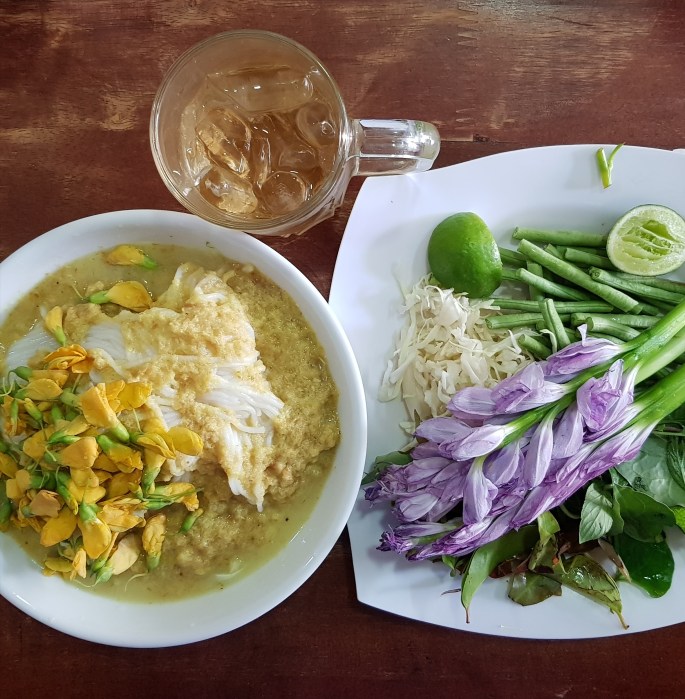
When we stop to eat I find out that Seth expects lunch bought for him as part of the deal. He has a fish curry soup, whilst my stomach issues lead me to choosing the plainest, bland option of boiled spring rolls. I don’t really mind buying his lunch, even though the touristy food prices here are double that of Phnom Penh. Afterwards we head off to another temple ruin, situated on the far side of a giant wetlands. As I walk through on a raised pathway, I pass fishermen and boys standing waist deep in water and half a dozen grazing water buffalo. The final stop is a tall temple where you can climb up to watch sunset, although having three hundred other tourists at the top spoils the moment somewhat. The entire upper level is crammed with people taking selfies and trying to pose for photos that make it look like they’re ‘holding’ the setting sun. I really can’t be arsed with them, even though I’m a tourist myself. I better get used to it though, because tomorrow I’m off to see sunrise at Angkor Wat, Cambodia’s premier tourist attraction.

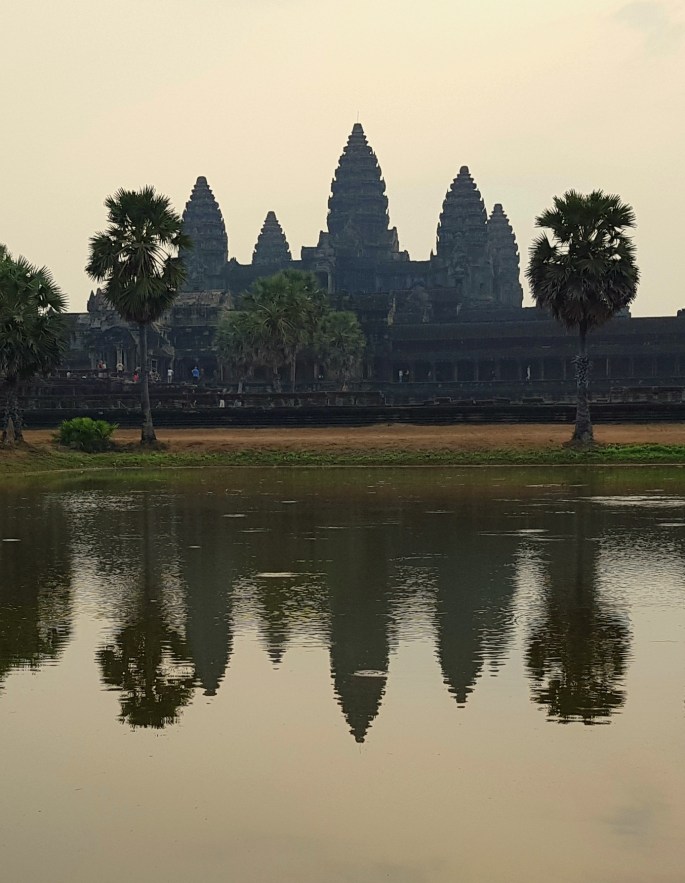
On the Sunday I’m up at 4.30am, collect my packed lunch from the guesthouse fridge and meet Seth outside for a tuk-tuk ride in the dark. We drive along Siem Reap’s famous ‘Pub Street,’ which still has food stalls trading through from Saturday night, as well as new ones setting up for this morning. Half an hour later we park close to the Angkor Wat site, and I follow the crowds, torches and lights that are marching towards the temple. I sit on a wall overlooking a rectangular moat that surrounds the complex, whilst a stream of flashlight-carrying tourists cross a pontoon in front of me to enter the temple grounds. Through the gloom I can just about make out the shadowy outline of Angkor Wat, the distinctive towers a slightly darker colour than the surrounding sky. Gradually it starts to get lighter, but there’s no spectacular sunrise with a band of cloud on the horizon. The sky colour simply moves from black, to grey and then into daylight.

The normal, fixed walkway over the moat is under repair, so I squeak my way across to the temple on a temporary plastic pontoon. I knew a lot of folk had crossed this way in the darkness, but I had no idea just how many until I see them all inside. There are thousands. Nearly everyone makes for the main temple like a flock of sheep, so instead I walk round the grassy outside of the grounds to try and get some sunlit photos from the rear vantage. Most of the stones used to build Angkor temples are really dull and dark, so this direct sunlight makes for a much better photo.

Then I climb up to join the hordes inside the huge main temple. It’s a spectacular spot, three levels high and supposedly one of the largest religious monuments in the world. What makes Angkor Wat so distinctive are the five enormous towers, four in each corner and one in the middle, set out like the Number Five pattern on a dice. The towers are shaped almost like tall acorns, adorned with ‘petals’ to make them look like lotus flower buds. Inside there’s a queue and a thirty minute wait to get to the highest level, so I forgo that to explore the terraces, galleries and storylines carved intricately into the stone walls. Most of my time is spent wondering how these wonders could have been constructed nearly a thousand years previously. My tolerance for tourist crowds isn’t great, so after a few more pictures I call it quits and return to meet Seth.

We carry on to Bayon Temple, which has more stone-carved storylines of battles and myths, dozens of huge, smiling Buddha faces on columns and about two hundred Chinese tourists. Then it’s the very cool Ta Phrom Temple, which was used as one of the locations when parts of Tomb Raider were filmed here. This temple is unique, as a lack of restoration and human interference has allowed it to remain in almost the same condition as when it was discovered. The surrounding jungle has encroached and taken over, with massive silk-cotton trees and strangler figs growing straight through the roofs of some buildings. Enormous gnarled tree roots twist and crawl over the ruins below, appearing to strangle them like giant, woody constrictor snakes. Visually, the place is astonishing, but the scrum of tourists queuing for pictures makes it hard work.

We head off for lunch, with me treating Seth again and opting for a mild fish curry served in a coconut. Over food, he tells me that Cambodia was actually bombed far more than Vietnam during the ‘Vietnam’ War. He and his friends would find mortar shells and grenades as kids, with one friend losing a finger after playing with a grenade that exploded. He then tells me his older brother was once kidnapped by the Khmer Rouge and forced to train with them, before escaping and making his way back home. I’m not sure whether to believe him, but then I reason that most stories from the Khmer Rouge era seem scarcely believable nowadays.

There are a couple of more temple stops on the way back, although I’m getting a bit templed-out by now. They all seem to pale in comparison after seeing Angkor Wat and Ta Phrom. On our return we stop alongside the moat that surrounds Angkor Wat, where Seth gives me a few more interesting snippets of information. I’m told that the moat used to contain crocodiles as a defence measure, and that if it ever dries up there’s a chance the Angkor Wat temple may collapse one day. Apparently the temple site is built on sandy ground that is kept damp by underground water wells. Now, with Siem Reap continually growing and attracting more tourists, there are many more new hotels and businesses that require access to water. All these new consumers then drill bores to tap into this underground water source. It’s ironic that the town has grown so much because of Angkor Wat, yet catering for all these tourists may end up damaging this crown-jewel of temples.

It’s roasting by mid-afternoon back at the guesthouse, so I have a swim and relax by the backyard pool. It never occurred to me until today that this swimming pool is probably using underground water that helps support Angkor Wat. I should feel slightly guilty, but I guess that Siem Reap wants to keep getting busier and busier as Cambodia becomes more accessible to mass tourism. I’m glad I got to see Angkor Wat now, before the town becomes even more stupidly crowded than it already is. It’s one of those places that would have been great to visit twenty years ago, just after Cambodia opened up to the world again. In the late nineties only 7,500 hardy travellers would come to Angkor Wat. Today that number has grown to over two million visitors each year. That’s a crazy transformation. It’s been a good few days though, despite the tourists, and great to see another ‘bucket list’ destination. Tomorrow it’s back to Phnom Penh and back on my bike.
The Killing Fields

14th MARCH 2019

My second Rest Day in Phnom Penh continues along much the same morbid lines as my first. Yesterday I learned that inmates at Tuol Sleng Prison were tortured into false confessions by the Khmer Rouge and then taken to a place called Choeung Ek to be executed. Today I’m going to make a short trip out of Phnom Penh to visit that location, the most notorious of the sites that came to be known as The Killing Fields.

As it’s only 17km away I decide just to cycle, heading South out of the city on streets that become steadily quieter with every turn I take. The final few kilometres include a road that has been constructed using prefabricated concrete slabs, with me jolting over the bumpy joins between sections every five metres or so. I leave my bike outside the Choeung Ek compound, chained to a supporting roof pole amidst scores of parked scooters. The attendant bloke gives me a paper ticket and says that parking will cost me 1,000 Riel (about 20p) when I leave.

I choose the audio-tour option again as I think this definitely enhanced yesterday’s visit to Tuol Sleng Prison. The extra information and personal back stories mean you build up a much clearer picture of events than if you just walked round randomly. It also appears that the same person has been given the job of narrating the English speaking version of both audio tours. I’ve now spent two afternoons in a row listening to shocking accounts of torture and brutality, all recounted in a reassuringly calm manner by a slightly German sounding reader. Before walking round the grounds, I sit on a bench and listen to the horrific chain of circumstances that led to this area being used as a Khmer Rouge execution site. What was once a peaceful orchard would soon become the mass graves where almost 9,000 victims of that regime were dumped.

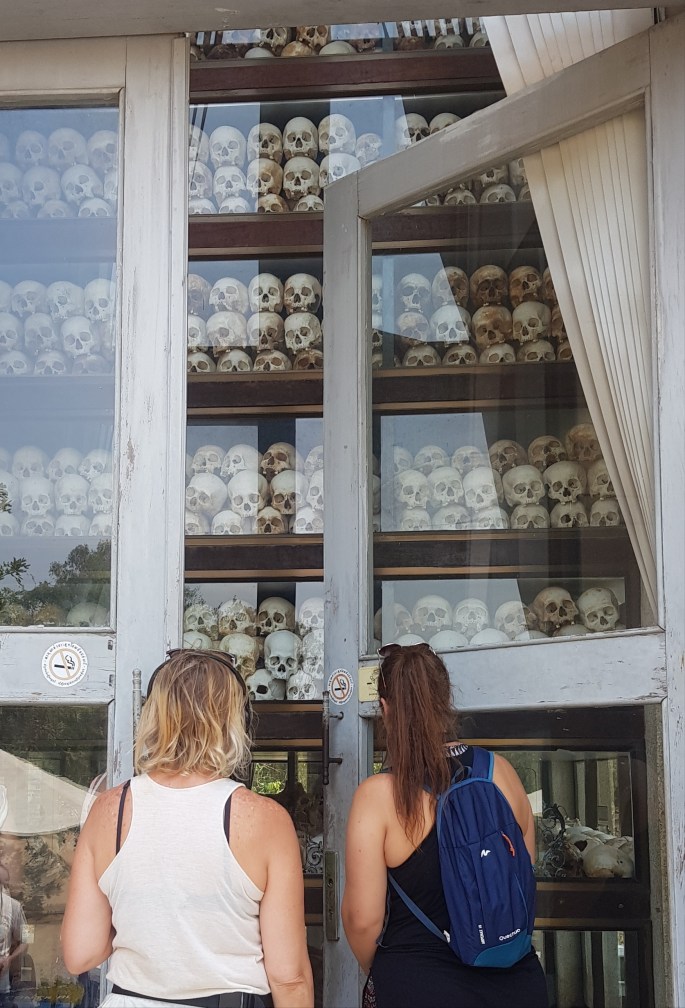
At the centre of the site is a large Buddhist Stupa, like a memorial, that is supposed to be the final stop on the audio-tour. However, a whole army of schoolkids have arrived at the same time as me so I visit the Stupa first to avoid having to walk round with them. It’s a tall, narrow building that houses around 5,000 human skulls as well as various other bones, teeth and clothing that have been dug up here over the years. The skulls are balanced three high on top of each other in central glass cabinets which, chillingly, rise to a height of nineteen levels. Squeezing round the building between the cabinet and outside wall I can see that many of the skulls show signs of being shattered or pierced by a sharp object.

Back outside I walk along paths that skirt round the areas where victims were buried. These sites are marked by large, deep depressions in the dry earth where bodies have been unearthed from dozens of mass graves. Not all of the graves have been dug up though; there are still at least five mass graves at this site where the Cambodian government has forbidden exhumation, preferring to let the victims rest in peace. However, this policy often leads to the macabre spectacle of bones and clothing resurfacing nowadays during periods of prolonged heavy rainfall.

Testimonies from former executioners detail how the victims were blindfolded and led to the grave site with their hands tied behind their backs. Here they were forced to kneel down and were usually killed by a blow to the back of the head using iron bars, sharpened bamboo or any other implement that was available. If this didn’t kill the prisoner they would be finished off by having their throat slit. Bullets were thought of as too expensive to waste. Once the grave was full the Khmer Rouge would throw DDT pesticide on top of the bodies to cover up the stench of decay, although this poison also helped kill victims who were buried alive. After a few days the ground above these graves would often rise up, due to escaping gases from the sheer number of decomposing corpses.

What happened at the graves is grim enough, but ‘The Killing Tree’ takes things to an even more abhorrent level. This is the location where children and babies were killed by being swung round and having their heads smashed into the thick tree trunk. When the invading Vietnamese first discovered this location they were puzzled as to why a tree would have blood, bone and bits of brain on its trunk. They were only able to work it out when they found children’s bodies in amongst the mass graves and saw the horrific head injuries they had succumbed to. Can you imagine killing children by holding their ankles and swinging their heads into a tree ? It’s a truly sickening thought. Today the tree trunk is adorned by bangles, bracelets and other colourful trinkets as a sort of memorial. It’s clear to see that this spot is the one that affects visitors most on this tour.

Although Choeung Ek is the most infamous of the Khmer Rouge execution sites, there are thought to be around three hundred such locations around Cambodia. It’s almost unthinkable to learn that Pol Pot’s regime were responsible for the deaths of nearly two million people. In less than four years one quarter of the Cambodian population were dead as a result of execution, disease or starvation. The Khmer Rouge rule only ended after Vietnam’s invasion, forcing it’s leaders to retreat West to jungles on the Thai border. They were relatively safe here as the Thais were happy to use them as a buffer between themselves and the Vietnamese. Bizarrely, because Vietnam were seen as an occupying force, the Khmer Rouge were still viewed as the rightful Cambodian government for many years afterwards by a number of countries, including the UK. By the mid 1990’s their support had dwindled, Pol Pot died in 1998 and a year later the Khmer Rouge ceased to exist. The surviving leaders were put on trial for genocide, but the ordinary soldiers were given amnesty if they surrendered, and now live freely amongst the Cambodian population.

It’s been another heavy-going afternoon but, again, I’m glad I made the effort to come here. I leave the site, try in vain to find the parking attendant and cycle off without being able to give him my 1,000 Riel parking fee. That’s 20p he’ll never see again. On the ride back towards Phnom Penh I get caught in a bit of a traffic jam and resort to cycling along the pavement like almost every scooter and motorbike rider.

At night I’m back in No. 72 Restaurant, still trying to order Tamarind Prawn from their menu, and still finding that it’s unavailable. By now I’m ravenous too, as I haven’t eaten anything since breakfast. In the end I opt for a tasty beef noodle dish with egg, vegetables and the most delicious sauce. As I’m sitting drinking my iced tea, I decide that I’m still hungry and order a second main meal, this time creamy chicken with rice.

Back at the guesthouse it’s so hot and sticky that Vanny brings chairs out to the pavement so we can sit and chat in the cooler air outside. I learn lots of little snippets about life in Cambodia; the fact that the number eight is considered so lucky that nearly every house number will contain an eight, even if this bears no relation to what position they are on the street. I’m also surprised to hear that almost nobody in Cambodia has car insurance. Anything other than a major crash gets sorted out by the two parties on the spot, and if your car gets stolen it’s just bad luck and you’ve lost it ! He says he can barely remember the Khmer Rouge era as he was only a child, living in his family village out in the countryside. I don’t ask about the rest of his family and he doesn’t mention it.

After a while his daughters return from extra Chinese lessons and I become an excuse for them to practice their English once again. It hits me how happy and carefree they are, and I think how lucky it was that they weren’t born a generation or so earlier. Their education and foreign language skills that are so useful today would have seen them killed in the 1970’s. I’m finding that a lot of my thoughts are Khmer Rouge related at the moment after immersing myself in their bloody history for the last two days. It’s time for something a little more uplifting. This will come in the shape of a side trip to Siem Reap tomorrow to see a much more positive symbol of Cambodia – the temples of Angkor Wat.

The Khmer Rouge

13th MARCH 2019

After riding in scorchingly high temperatures for eight days straight, it’s such a relief to get up late and not have to think about cycling. I’m feeling the same sense of relaxation that a Monday to Friday worker would feel when they open their eyes on a Saturday morning. And, even though a cycle trip bears very little comparison to work, it’s still lovely to have a day off.

The question is what should I do with a day off in Phnom Penh ? There are plenty of options from food tours, temples, visiting the Royal Palace or taking a sunset cruise on the Mekong River. It takes a bit of deliberation, but I finally decide I’m going to explore a very dark chapter in Cambodia’s history and visit the Tuol Sleng Genocide Museum. Even beforehand I know that it’s likely to be a sad and sobering afternoon, yet somehow I still have a strong urge to visit the site. I know that people who go to Auschwitz say their visit helps them learn and remember the past, and in this way such genocides are never repeated. I’m not so sure though. The horrors of Rwanda and Bosnia took place twenty years after the horrors of Cambodia, which in turn took place forty years after the horrors of Nazi Germany. I don’t think we ever really learn. Human beings will always be capable of staggering levels of brutality under the wrong leaders or the wrong circumstances.

In Cambodia’s case the wrong circumstances came about as a result of an overflow of the Vietnam War alongside the country’s own Civil War. The ultra-communist Khmer Rouge forces were able to overthrow the Cambodian government in 1975 and went on to impose their barbaric and inhumane regime on the unstable country. Under their fanatical leader, Pol Pot, the Khmer Rouge sought to turn Cambodia into the purest of communist states. His vision for the country included evicting citizens from all cities, forcing them to work on the land and making the country completely self sufficient. The regime isolated Cambodia from the outside world, stopped foreign imports, closed all schools and banks, banned religion and forbid anyone from owning property or having personal possessions. White collar workers would be sent to work on farm collectives for fourteen to sixteen hours per day with absolutely no idea what they were doing. Thousands died from overwork, disease or starvation.

The Khmer Rouge soldiers were mostly recruited from uneducated and easily manipulated peasants, who now had a steady job, food and a little bit of power. In the truest communist sense, peasants were now equal to the urban elite. People who were educated, had ‘soft hands’, spoke a foreign language and any employee of the previous government were all seen as enemies of the state. Along with teachers, academics, lawyers, artists, monks and foreigners, they were rounded up, tortured and sent to be executed. This is where the grim Tuol Sleng Prison (or S-21) comes into the picture.

When I show up there’s already a number of Western tourists milling outside and queuing at the entrance. I buy an audio-tour with my entry fee, put the headphones on and am transported back to a terrifying time in the late 1970’s. The first thing that hits me, for all the horrors that took place here, is just how ordinary the place looks. What became such a centre for suffering was once an everyday high school. There are five buildings, all three storeys tall, arranged round three sides of a rectangular courtyard of green lawns and palm trees.

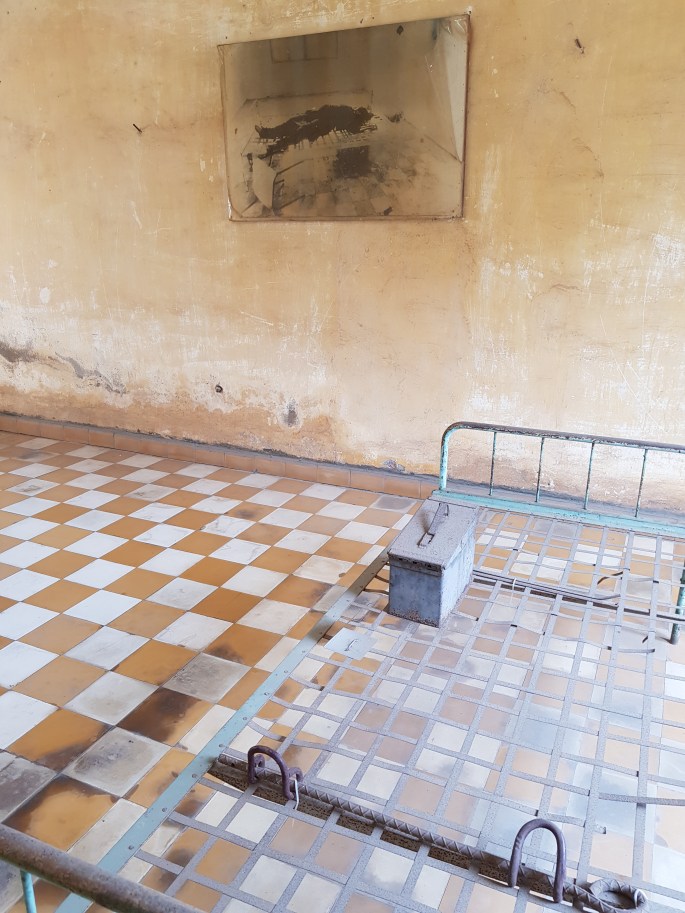
Building A occupies the left side of the courtyard and is where most of the torture took place. Each bare room has dirty, yellowing walls and a floor with alternately coloured orange and white tiles. These used to be classrooms, but desks were removed in favour of a single metal bed, bolted to the floor and to which prisoners were shackled hand and foot. They would be immobilised and helpless as they were tortured into signing false confessions which implicated their friends and family members. To gain this information the prisoners would be beaten, electrocuted, have fingernails pulled out and even experimentally operated on. I’m staggered that one human being can do this to another, especially when the torturers knew their victims were innocent.

In each of the ground floor rooms there is a large picture on the wall of that room’s final victim, lying dead and still shackled grotesquely to the same metal bed that sits here today. Mercifully, The Khmer Rouge were eventually ousted in 1979, after the Vietnamese Army invaded Cambodia to defeat them. The victorious soldiers swept into Phnom Penh so quickly that the Khmer Rouge essentially just dropped everything and ran, without having time to cover up their atrocities. About two days after arriving in Phnom Penh, the Vietnamese soldiers noticed a stench coming from this very building, went to investigate and found the grisly sights within.

Buildings B and C run along the rear of the courtyard, with crudely built single cells on the ground floor and mass detention rooms on the top. These large cells held around forty people, crammed in like sardines and lying top to tail, chained to the walls by their ankles. To wash the prisoners a guard would simply put a hose through the iron bars once a week and spray them all. Malaria, ringworm and other skin diseases were rife. Part of the ground floor is given over to an eerie, black and white picture gallery, some of which are prison mug shots and some of which are head shots of deceased victims. In many pictures their glazed, dead eyes are still open and staring hauntingly upwards. Many of the victims are women, teenagers and sometimes even children. If a prisoner made a confession and was executed, the regime would then kill their entire family so there was no-one left who could take revenge later. There are also pictures of Khmer Rouge soldiers, the ‘cadres’, all dressed in black and, unsettlingly, most of them appear to be teenagers.

Building D shows various instruments of torture and has individual stories from the very few survivors. There are accounts of women prisoners being raped and of mothers having their babies killed in front of them. Again, I just cannot fathom how humans can descend into such savagery, save for the old ‘I was only following orders’ excuse. The regime made sure the teenage soldiers did follow their orders though, as any failure to do so would quickly result in their own execution. Apparently, almost one third of Tuol Sleng’s prison guards were also killed as the regime’s paranoia began to take hold. The last section of this room has a number of human skulls on show in glass display cabinets. On some of these skulls I see dents, holes and fractures, disturbing indications of a brutal and violent death. I exit the building and sit on a bench outside while listening to the final section of the audio-tour, as well as some personal testimonies from inmates and former guards. It’s desperately surreal to be sitting here on a beautiful sunny day listening to the horrendous stories that took place forty years ago at this very same location.

After prisoners made their forced confessions, they were then able to be trucked away and executed in a location known as Choeung Ek, about 15km South of Phnom Penh. A Cambodian journalist coined a term in the 1970’s that is still widely used today to describe the mass execution sites around the country – ‘The Killing Fields.’ Out of an estimated 18,000 prisoners who passed through Tuol Sleng Prison, there were only twelve known survivors, of which five were children. This handful of survivors were either children who hid when the prison was evacuated or adults who had shown themselves to be of some use to the Khmer Rouge. An artist was kept alive to paint portraits of Khmer Rouge leaders, while another was spared because he could repair the regime’s typewriters and sewing machines.

One of these survivors, Chum Mey, takes up residence most days at a shaded stall in the courtyard, selling autographed books recounting his time at the prison. In the book he tells of getting so hungry in prison that he would resort to eating rats that scurried into his cell. He’s also still deaf in one ear as a result of having electrodes shoved in there during electrocution torture. He just looks like an ordinary, humble old man. Part of me is astonished he would choose to spend so much time here after what he went through. Then I read the blurb on his stall, which tells me he wants to spread the message to foreigners about what happened here during Khmer Rouge times and to make sure it’s never forgotten. Vanny tells me later that these books are his only form of income.

The museum is as depressing and confronting as I imagined it would be. I think this feeling is exacerbated because the site has remained almost untouched for forty years, a stubborn reminder of the sinister past while a new modern city has built up around it. As I walk back to my guesthouse I can’t help thinking about the sense of fear and hopelessness the prisoners must have felt. Their fate was inevitable; they would be tortured until confession, then trucked away in the middle of the night to be executed. And they would have known with certainty that this was their future.

Looking back at these events now, it seems almost unbelievable that they actually happened. I remember when I was a kid, hearing snippets on the news about Cambodia and The Khmer Rouge, but I really had no idea of the full, shocking extent of what went on. Todays visit has filled many gaps in my knowledge from that era, although I have to say it’s done nothing for my faith in human nature. Back at the guesthouse I tell Vanny where I’ve spent my afternoon. He just looks at me and nods his head ever so slightly. Cambodia has moved on massively from those tragic days, but anyone over forty-five will remember and will have had their lives shaped in some way by those terrible events.

Power out in Phnom Penh

11th MARCH 2019

After leaving my motel I trundle round Svay Rieng for ten minutes trying to find somewhere that’s open for breakfast. I’m finding that street food stalls and Plastic Chair Cafes are nowhere near as abundant in Cambodia as they were in Vietnam. In the end I find an outdoor restaurant who say they will feed me even though it looks like they’re not open for business yet. A girl takes my order by showing me images of meals on her mobile, while I try to keep things simple by pointing to a plain fried rice. She leaves me a little basket of drinks on my table to start with, which consists of water, Pepsi and melon tea. The melon tea sounds interesting so I try that poured into a big glass over ice. My God it’s refreshing and it tastes brilliant ! Then my fried rice dish arrives, with an unexpected bonus of squid, baby octopus and a couple of large prawns. I can’t get my head round people who skip breakfast in the morning.

Once I leave town I’m back onto Route Nationale 1 again, heading West with the sun blazing down on my back to begin with. As the day moves on the sun climbs progressively higher, until soon it’s overhead and my exposed forearms are bearing the brunt of its relentless rays. And, just to compound things, it’s another bloody scorcher today. By mid-day I’m flagging, so stop for lunch and a break at a Plastic Chair Cafe on the opposite side of the road. I pay 10,500 Cambodian Riel for an average beef noodle soup along with a can of mysterious fizzy juice that is a vivid, luminous green in colour. I’m beginning to notice that food and accommodation are slightly more expensive than in Vietnam, even though Cambodia seems a poorer, less developed country. Still, in the big scheme of things it’s only £2 per meal, so I’m not exactly complaining. When I leave, the owner bloke tells me to be careful with my bike in Phnom Penh. This might be fair warning, but I also know it could be someone from a country town being a bit apprehensive about the big city. I’m hoping it’s the latter.

The afternoon is a hot trudge through brown, bone dry countryside. It’s so ridiculously hot that it’s starting to affect the water bottles I have strapped to the rear of my bike. They’ve been in direct, blazing sunlight for over three hours now, and are so horribly warm that it feels like I’m drinking bathwater. I stop to buy some chilled water and continue my slow Westward slog, arriving in the town of Neak Loeung just after 2.00pm. Finding my guesthouse proves to be less than straightforward though.

Both Google maps and my accommodation booking site show the building in the same place, but annoyingly they are both completely wrong. I faff around the bumpy, unsurfaced streets for a while trying to locate the place myself before I resort to asking the locals. The only method I have for doing this is to show a picture of the guesthouse on my phone, which draws a couple of blank faces, before a third guy says he recognises the location. He goes to get his motorbike and beckons me to follow him, delivering me to the guesthouse within a minute. In reality it was just round the corner, but would have taken me ages to find on my own, if at all.

The bloke then comes in to act as interpreter between me and the guesthouse owner. I’m told that a room with a fan will cost 6 US Dollars per night, so I hand over $10. Normally this would mean a simple transaction with me receiving $4 change, but of course I know I’m going to get my money back in Cambodian Riel. I think I’ve worked it out though, as 1 US Dollar equates to 4,000 Cambodian Riel, which means that for my $4 change I’ll be due 16,000 Riel. At first the owner tries to palm me off with 3,000, so I tell my interpreter friend that I know it should be 16,000. He translates this to the owner who (miraculously) manages to find the rest of my change and apologises for his ‘mistake.’ I’m glad I know what I’m doing now. The upstairs room is basic at best, with cobwebs hanging lazily from the ceiling and a shower that operates on one constant, cool temperature. This chilly shower isn’t so bad mind you; my phone told me it was thirty-seven degrees when I checked in.

In the early evening I go for a walk and to search for some food. Neak Loeung turns out to be quite a scruffy, dusty town right on the East bank of the Mekong River. I try to make my way down to the river’s edge, walking along a messy street that’s lined with stalls, cafes and modest houses, only to be thwarted by tall, corrugated barriers between me and the waterfront. I walk back for food, realising that I must stick out like a sore thumb in a town that would normally be bypassed by most tourists. The locals are a friendly bunch though, to such a degree that I’m taken aback by the amount of people who smile or say Hello as I pass.

For dinner I find myself sitting outside a cafe, while a young guy gets me to choose food by showing me pictures on their menu. I point to one dish and he shakes his head, then try a second and he shakes his head again. This isn’t going particularly well. In the end he points to Fried Rice with Seafood and I just nod my agreement, even though it will be my second helping of this meal today. As I wait I watch the staff come and go, which mostly involves them playing on their phones. One girl is trying to take a selfie on a ten second timer, but every time the countdown reaches zero the young guy who took my order puts his foot in front of the camera to ruin her picture. I have a bit of a laugh at this and pretty soon we’re all friends and they’re taking selfies with me too. The people here just seem very open and warm. I can’t imagine this kind of spontaneity happening in Vietnam, where the locals behaved in a more reserved and detached fashion. I’m beginning to like these Cambodians.

When I return to my shoddy accommodation I’m plunged into darkness for half an hour by a power cut, which is destined to become a recurring theme here in Cambodia. In between power cuts, the fan will remain trained on me all throughout the hot night.

The following morning I return to the sister restaurant of the one I ate dinner at last night. It’s situated right across the road from the first and I recognise some of the staff, thinking they can’t have had much rest after working a late shift yesterday. I have a beef noodle soup that includes some tiny, puzzling meatballs, before leaving Neak Loeung and its rutted, uneven roads. I’m quickly back on Route Nationale 1 and heading for a huge new 2km bridge that will take me over the mighty Mekong River. Financed by Japan and only open since 2015, this is now the longest bridge in Cambodia. If I’d been doing this trip four years ago, I’d have been crossing the river by ferry. There’s quite a slope to get to the highest point, where I join a dozen or so scooterists who have stopped to take selfies and pictures of the scenes below. I freewheel down the other side, taking care when I go over a series of chunky rumble strips with my damaged spoke.

After the crossing I turn North for a while, the Mekong flowing idly along in the opposite direction a few hundred metres to my right. It’s shaping up to be another hot day, although I’m buoyed by the fact that the road surface has improved somewhat since getting over to this side of the river. I make good progress till lunchtime on these smoother roads, where a Plastic Chair Cafe serves me up yet more beef noodle soup, even though I’m sure I asked for rice. A jug of iced melon tea goes down a treat too, and I start to think this beveridge may overtake iced coffee as my favourite drink whilst on the road. I’m usually slow after lunch, but the increased volume of traffic as I near Phnom Penh seems to speed me up subconsciously. By early afternoon I can see tall city buildings in the distance, and by 2.00pm I’m checking in at Vanny’s Peaceful Guesthouse.

I’m greeted with a chilled water by Vanny’s wife, before the man himself makes an appearance. He’s a lovely bloke with good English and a wealth of information on Phnom Penh, having spent years working as a tour guide and taxi driver in the city. I check in, chain my bike to one of their unused motorbikes inside the front gates and sit down for a chat. I’m given yet more water and some mini bananas, before I’m shown to my room up a metallic spiral staircase that is as ridiculously steep as it is narrow. After showering I head round the corner of the block to No. 72 Restaurant, recommended by Vanny as every meal costs 2 US Dollars and you get unlimited free tea. With all today’s noodle soup consumption, I decide I should probably have some variety and order a rice meal to change things up a little. Being so used to eating on the go, I just ask for chicken and rice on the way into the cafe, before discovering their stack of menus and all the tasty options I could have chosen. Still, I’m sure I’ll be back.

When I return to the guesthouse, almost the entire street is in darkness due to a power cut. A college across the road and a couple of large apartment blocks must have their own generators as they still have lights, but otherwise the street has been left in dim twilight. Vanny and his wife can’t be apologetic enough and are mortified they don’t have electricity for their paying guests. He seems to think the electricity has been shut off deliberately by the power company to save energy, and that different city blocks will be without power for a period tomorrow. Apparently the combination of a massive increase in construction work and unusually hot weather has pushed the city’s electricity supply to it’s limits. I’m also surprised to learn that Cambodia has to import large portions of its electricity from neighbouring Thailand, Vietnam and Laos.

In the end we all sit on chairs on the pavement while Vanny’s wife brings out candles, water and slices of watermelon. With the family, guests and neighbours all sitting together outside, it feels like a nice little village community in the midst of a big, bustling city. It’s good to feel part of the neighbourhood as we all sit and watch the world go by in the gloom, with some motorcyclists inexplicably still choosing to ride up the street without lights. Vanny keeps encouraging his twelve and ten year old daughters to talk with me to give them a chance to practice their English. They already do extra lessons after school and are not too far away from being fluent, especially the cheeky ten year old. It turns into a really pleasant evening just sitting outside on the pavement and chatting, whereas normally you’d expect a power cut to be a nuisance.

It’s only when the mosquitos start biting that I finally head inside about 10.00pm. The power supply has been off for six hours at this point. I make my way upstairs by candlelight, blindly knocking the fan off the wall in my room as I enter, and settle in for what could be a sticky night without electricity. My consolation is that there’s a mosquito screen on the window, so at least I can open that to cool the place down a little. I’ve been in my room for all of two minutes when the electricity comes back on. I plug the fan in joyously and direct it’s refreshing airflow straight onto me. I’m glad my days off in Phnom Penh look like they will now feature electricity. I’m also glad I don’t have to get up and cycle tomorrow.


Holiday in Cambodia

10th MARCH 2019

After cycling out of Vietnam, there’s a strange two hundred metres of nothingness before I reach the Cambodian border crossing. Straight away the architecture at this end of the border post feels different from Vietnam, the main building looking more like a temple with curved, upturned roof corners. Notices written in Khmer script are completely unintelligible to me as well, with none of the weird, squiggly letters before me bearing any similarities to their English counterparts.

My bike is chained to a bench and I venture inside to join a queue that leads me to a stocky, middle-aged lady at a passport booth. When it’s my turn she just points dismissively to a separate section where I have to get my copy e-visa stamped by another official first. She looks like she enjoys her little bit of bureaucratic power. I traipse over to the correct department, get my bit of paper signed and dated, before returning triumphantly to the grumpy woman. This time she simply chucks down an Arrivals Card and says ‘You fill that in.’ I take the card and thank her sarcastically, but then realise I better watch my mouth as she could deny me entry if she really wanted to. So, dutifully I join a table of Japanese tourists, borrow a pen and fill out my Arrivals Card. Then it’s back to the passports queue where, thankfully, the surly woman seems to have disappeared. Unfortunately, my rejoining the queue coincides with her return, and I’m shouted back for one last encounter with her. I’m preparing for more power-hungry red tape nonsense, but she just checks all my paperwork and stamps my passport with a heavy thud. I now have one month in Cambodia !

After crossing the border I’m immediately struck by the amount of casinos lining the main road, making the first few kilometres look like a mini Las Vegas. However, this tacky casino strip is not for Cambodians – it only exists so that Vietnamese can pop across the border from their own country where gambling is illegal. Their appetite for betting must be huge as there’s even more hotels and casino resorts under construction as I pass. The whole area resembles a building site, with the road I’m cycling on reduced to a dusty, gravelly track in many places. I crawl ponderously through this section, travelling not much faster than a brisk walk, and make a return to worrying about punctures once again.

The other thing to hit me is just how blisteringly hot it has become, with the temperature hovering at a baking thirty-six degrees. I’m gasping for water, so stop in the dust at a roadside shop with stalls out the front. I’m not sure how communication is going to pan out so I just grab one of my large water bottles, show it to the owners and raise a single finger to indicate I’d like one. The owner lady goes all the way to the back of her shop to get me a chilled bottle, while I’m able to chat a tiny bit of English with her teenage kids. The transaction that follows then leaves me feeling a little confused, as Cambodia uses both US Dollars and their own Cambodian Riel. I hand over one US Dollar to cover my water and then receive my change back in Cambodian Riel. I’d heard this would happen, but in the moment I’m unprepared and have no idea what the exchange rates are. I just say Goodbye, pocket the change and will try to make sense of it later.

Tonight’s destination of Svay Rieng is about 40km from the border, although it turns into a slow, stuttering plod with the bumpy roads and exhausting heat. My rest stops become more and more frequent through an arid, flat landscape of dry season brown. Although the land is currently parched, I notice many roadside houses built on high raised columns, testament to the flooding threat in wet season. These houses are elevated a good three metres above the ground, so I imagine the road I’m now cycling on may find itself underwater in a few months time. This part of the country seems like it would be quite an inhospitable place to live – baking hot in dry season and flooded in wet. However, despite the harsh surrounds, my first impressions of Cambodia are positive. As I roll slowly along I notice that I’m getting a lot more ‘Hellos’ than I did in Vietnam, and from adults as well as kids.

About 5km from town I’m able to pull off onto a minor road which is, ironically, a far smoother ride than the Route Nationale One. I cross a bridge that’s under repair by darting between barriers and am at the Riverside Villa Guest House soon after. The reception building looks very grand, a two storey mansion overlooking a river with columns, mirrored windows and a balcony at the entrance. However, I’m in a ten dollar motel room out the back. When I chain my bike outside I notice that one of my wheel spokes has become detached, no doubt a consequence of the awful roads I’ve been cycling on today.

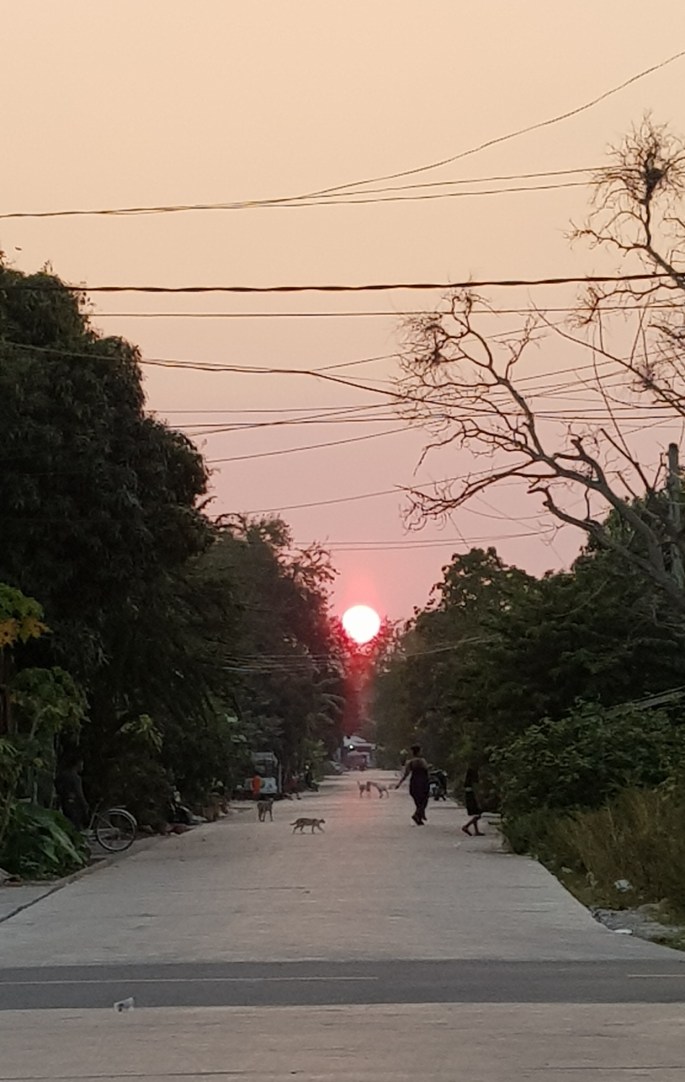
In the evening I venture our for food, aiming for a little cafe I’d found on Google maps. I’m back to pointing at foodstuffs to make my order once again, although the owner does make me smile by saying I can have ‘cow with egg noodle’. She boils up a fresh batch of noodles behind me, while I drink tea poured from a porcelain teapot into a glass with ice. By the time I’m finished the sun is dipping towards the horizon, casting an orangey-pink glow all over town. I walk back to my motel room through a series of grid-pattern streets that face directly West into the setting sun. On each road I cross it looks like there’s an orange ball, levitating just above the far end of the street. Some of the locals seem a little bemused that I’m taking so many pictures pointing down a street that’s so ordinary and commonplace to them. Maybe if I lived here this would be a normal, everyday sight, but for me in paparazzi mode it’s a striking image.

When I get back I book accommodation for tomorrow and also give myself three days off in Phnom Penh, the nation’s capital. By that time I’ll have cycled seven days out of eight in temperatures that have been steadily creeping towards the mid-thirties. Although the daily distances haven’t been huge, I begin to feel drained cycling every day in that kind of heat. I’ll be glad to reach Phnom Penh, have some Rest Days and play tourist for a while.


Getting out of ‘Nam

9th MARCH 2019

After last night’s abominable feast, my hotel breakfast this morning is a more subdued egg on toast with tomato and cucumber. An old Vietnamese lady with curlers in her hair, looking like she’s just woken up, shuffles into the room and sits at the next table. She strikes up a conversation and invites me to sit opposite her for breakfast. I discover she’s from Ho Chi Minh City originally, emigrated to California in 1992 and has returned to Vietnam to visit family. Today is the final day of her holiday, having spent a whole two months living in this hotel. She has beef noodle soup while I’m munching my eggs on toast. I tell her this breakfast is unusual for me and that I’ve been eating mostly Asian food on this trip, but I’m pretty sure she doesn’t believe me.

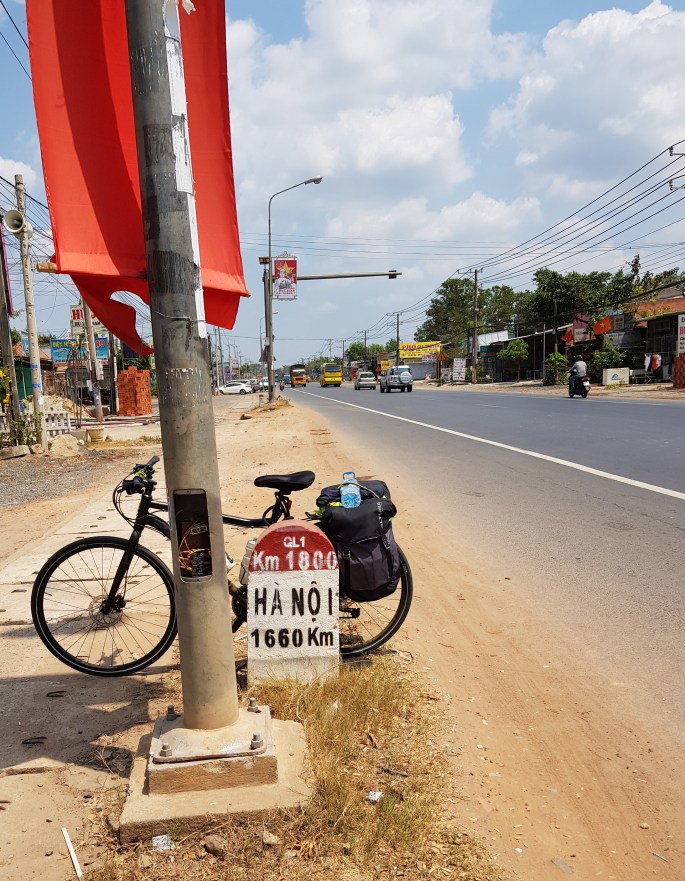
To begin today’s cycle I act like a local, creeping along beside the pavement on the wrong side of the road and into oncoming traffic. I’ve resorted to this tactic as I’m not able to cross the road due to a solid line of concrete safety barriers between the carriageways. I slink back to the big roundabout I used yesterday and take an exit that will lead me West towards the Cambodian border. This is significant as I can now leave the big, busy QL1A road behind, having been cycling on it regularly since leaving Hanoi eight weeks ago. Even though it’s helped me ride the length of Vietnam, I can’t say I’ll miss it.

What could have been a potentially awkward day negotiating the outskirts of Ho Chi Minh City turns out to be a lot easier than expected. I take a bridge over the Dong Nai river, leave the main road and pootle along a quiet-ish route beside the river. I’m also managing to stay out of the sun today, enjoying the welcome shade from roadside trees and buildings as well as some protective cloud cover.

Just after Thủ Dầu Một, one of Saigon’s satellite cities, I’m back onto the main road to the border and stopping for lunch at yet another Plastic Chair Cafe. I choose rice as my carbs, while the lady at the counter asks what I’d like to go with it. As usual I don’t recognise the contents of half the trays, so I opt to play it safe by abstaining from meat and point to what looks like a tofu dish. When the food arrives, what looked like a vegetarian meal in the display tray ends up containing chicken and beef as well as tofu. I’m fine with this, but it does get me thinking how difficult my trip might have been as a vegetarian. With my meal I receive a small bowl of clear soup containing potato, and also one other dish that’s not quite as easy to identify. It looks like another soup, but this time there appears to be a giant gherkin resting in the middle. I cut the huge vegetable in half to find that, bizarrely, the insides have been stuffed with sausage meat. The soup and sausage meat taste fine, however the gherkin thing tastes way too bitter and pickled for me. A quick Google search later reveals that this dish is called Kho Qua, which is in fact bitter melon stuffed with minced pork ! Second helpings of iced tea help cool me down as it’s becoming a sticky old afternoon, despite the cloud cover.

Back on the road I’m almost at the town of Cu Chi, famous for the Cu Chi tunnels used by North Vietnamese soldiers during the Vietnam War. These connecting tunnels once formed part of a vast underground network of supply routes, hiding spots and storage dumps. Soldiers sometimes lived in these dark, cramped tunnels for several days at a time alongside rats, stinging ants and mosquitos, only emerging at night to forage for food or to shoot Americans. As an aside, I learn that during the Vietnam War malaria was the second largest killer of Vietnamese soldiers. Today the tunnels are a tourist attraction, but now Western adults have trouble fitting into the pits that were once barely wide enough to house Vietnamese kids.

My accommodation is almost a kilometre from the main road, giving it a countryside feel of being out in the sticks. I’d also noticed on Google maps that it was advertised as a ‘Love Hotel’. Sure enough, as I check in, a young couple are checking out. Evidently you can pay by the hour here, as well as per night. I don’t think it’s really for prostitutes though, more for young couples who still live at home with their parents and need to come here for some ‘private’ time. One of the first things I notice in my room is a bright orange, curvy recliner that looks like an art gallery sculpture, but is more likely to be an imaginative Love Hotel prop. The young guy who runs the place puts the TV on to an English speaking channel because I’m a Westerner, then tells me all about the accommodation while Baywatch The Movie is running in the background. He’s a good kid, even offering to go into town on his scooter and bring back some food for me, which he says he will get at ‘Vietnamese prices’. I shower and watch the second half of Baywatch whilst reclining on the Love Hotel sculpture chair. Surprisingly, it’s really rather comfortable.

Later, the manager bloke tells me where I can get food in town and seems genuinely shocked that I’m going to walk a kilometre to get there. I end up in a small supermarket stocking up on Cup Noodles, cakes and yoghurt drinks, making sure I have enough for dinner tonight and also for my final Vietnamese breakfast tomorrow. I’m just about to drift off to sleep when I become aware of some ‘Love Hotel’ squeaking from the room next door. Thankfully they’re quick about it.

I’m up a bit earlier than normal the following morning as I’ve got a long, hot 90km day ahead of me. I’ve also got a border crossing to negotiate, and there’s no telling how long that process may take. Still, in a few hours time I should be in Cambodia. I’m excited and a little nervous about the prospect of a new country, having spent almost two months in Vietnam. I’ve got used to how things work here with regards to food, accommodation, currency, roads and even tiny snippets of the language. I’m going to have to start my learning from scratch again once I get over the border. But then, these new experiences and different perspectives are half the point of travelling.

When I go to pay for my room the young manager bloke gives me too much change back by mistake. His blunder happens as the 20,000 Dong and the 500,000 Dong notes are both blue in colour. The poor chap absent-mindedly hands me back 500,000 Dong instead of 20,000. I should say something, but I don’t. I justify my behaviour by thinking of all the times I’ve paid ‘foreigner’ prices or simply been overcharged on this trip. This way I figure I’m getting all my rip-off money back in one lump sum on my last day in the country. Essentially, the unfortunate guy has just given me a free night’s accommodation and will also be paying for my final food stops in Vietnam.

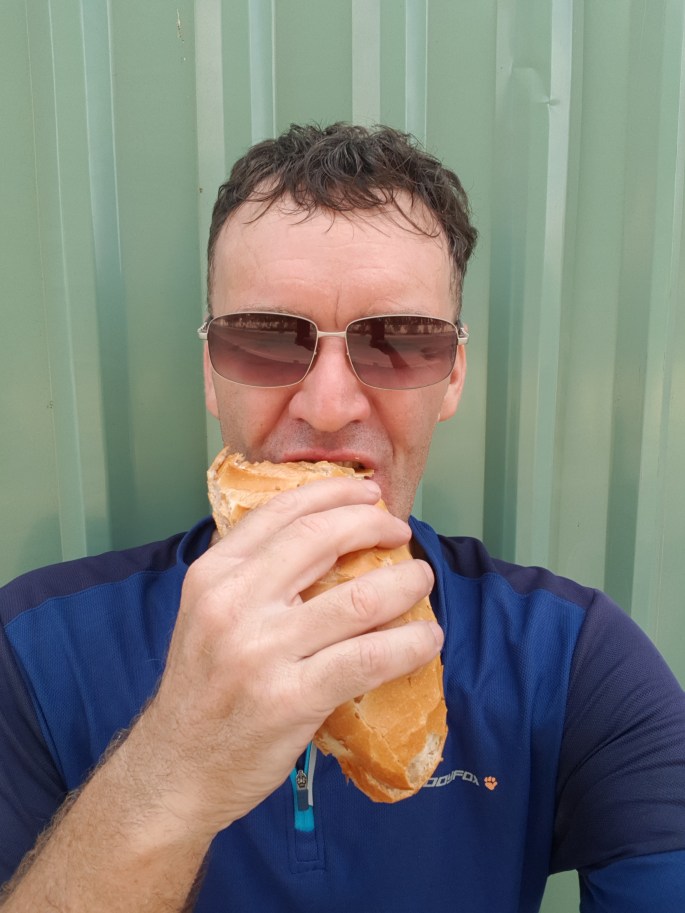
I stop for my last Banh Mi breakfast, which is pretty standard fare, and take a selfie to commemorate the occasion. There will be a few ‘lasts’ today. Through the town of Cu Chi itself, I reach a massive junction and take a road that will transport me through my final 40km in Vietnam to the border. My Plastic Chair Cafe lunch is a chicken, rice and green beans offering, washed down with a cooling jug of iced tea. The kilometres are passing quickly today and, before I know it, I’m only 5km from the border. At this point I decide I’d like to have one last Vietnamese drip-filter coffee, and shoot across the road to a cafe on the opposite side. I still have to ask for my drink via mimes, even though I know that coffee with milk is ‘Ca Phe Sua’. I’ll have to learn the Cambodian equivalent for that pretty quickly. Disappointingly, they have no drip-filter coffee so I have to settle for ready mixed poured on top of condensed milk. I mix it all together then pour the whole lot into a glass with ice, which still has the desired effect.

Then I’m at the border. My visa runs out tomorrow, so I’ve definitely made the most of my time here. I never know what to expect at border posts; this one is somewhat chaotic and antiquated with no clear instructions on what to do or where you’re supposed to go. I chain my bike outside the building and wander in a side door where a dodgy looking guy latches on to me, saying he can help get my passport stamped for a fee of 100,000 VND (about £3.50). It turns out his entire task would be to point me to the correct queue and stand beside me while I do everything else. I tell him ‘No Thanks’. Instead I join a queue full of Asian tourists and within ten minutes I have my exit stamp from Vietnam safely in my passport. Back outside I reclaim my bike and have about two hundred metres of what looks like ‘No Man’s Land’ before the entry point for Cambodia. I’ll be in between countries for a short while.

My time in Vietnam, though, is over. Two months and over one thousand miles of cycling has taken me South from a cool Hanoi winter to a swelteringly hot day on the Cambodian border. I can honestly say this has been one of my favourite ever countries to cycle through. The roads can be a bit challenging at times with crazy traffic, constant horns and roadside litter, but I’ve still loved it. The people have been generally polite, helpful and friendly, even with the inevitable language barriers. The flip-side is that many will happily chat to you so they can show off to their friends or practice their English. Food has been cheap and healthy, even though there’s been some interesting times when I’ve not been entirely sure what I’m eating. Parts of the country are very built up and heavily populated, yet I still witnessed some stunningly gorgeous scenery almost every day. And finally, this has to be one of the safest countries I’ve ever travelled in. I’d feel much safer with the prospect of walking through the eight million population of Hanoi at night than I would through any UK city. Vietnam was a bit of an unknown for me eight weeks ago, but now I’m a huge fan. If this country is not on your bucket list, then it definitely should be !


Bypassing Saigon

7th MARCH 2019

There’s no breakfast option at my Tan Nghia accommodation, so today’s food consumption starts with my one remaining banana from yesterday. I’ve resumed cycling on the busy QL1A road again, and am destined to remain on this frenetic monstrosity for the whole day. Although I’m creeping ever closer to Ho Chi Minh City (Saigon), I’ve decided that I’m just going to bypass this massive metropolis and head straight for the border. I really have no desire to cycle into a sprawling city of eleven million inhabitants, only to fight my way back out again when I leave. I’ll still have to skirt round the city, but I’ll be keeping well away from the centre.

Because I’m now heading West, the morning sun is beating down on my back for a change. It’s good that my forearms will finally get some relief from the the sun, although I’ll now have to pay more attention to protecting the back of my neck and ears. I set off at a brisk pace this morning, covering half of today’s distance in no time. Then the road gets progressively busier, the day becomes hotter and I have to stop for an iced coffee just to cool down. I have the old Vietnamese drip-filter coffee which falls, drop by drop, into a glass containing condensed milk at the bottom to act as a sweetener. It takes a few minutes for all the coffee to filter through, before I give the mixture a stir and tip the whole lot into a bigger glass full of ice. My God it’s refreshing ! The good thing about cafes in Vietnam is that you nearly always receive a jug of cold tea along with your order as well. So now, through a heady combination of iced coffee and cold tea, I’m rejuvenated and ready to go again.

Fuelled by caffeine, I continue in the heat once more towards a lunch of curried chicken, rice and veggies, accompanied by a bowl of sinister looking clear soup with gherkins. By late afternoon it has become exhaustingly hot, with the sun having moved overhead to beat down relentlessly on my forearms once again. After such a speedy start this morning, the final 20km drags by in sweltering slow motion. I cut off the big road for the final half hour, plodding my way lethargically to a modern, family run motel that is spotlessly clean. The owner is a genuinely friendly and hospitable guy, even though communication between us is a bit of a struggle. He sees how hot and knackered I look at check-in and gives me two extra bottles of chilled water to take to my room. He also prints out two copies of my Cambodian e-visa, after I make my request through the wizardry of Google translate. When I shower I give my sweaty cycling top a rudimentary wash on the floor by trampling it under my feet and soaking it with shower gel as I clean.

There’s a number of dinner options on the same street as my motel, although I avoid the busy ones and the karaoke venues. For some reason I’m drawn to a tiny Plastic Chair Cafe, where a young guy is displaying his wares at a food stall that looks like it’s been set up on the driveway of his family home. I can see trays of chicken’s feet and various other body parts which look nauseatingly grim, before I settle for something that vaguely resembles curry. My seat in their driveway is right beside the lounge window, where a little girl of about five keeps popping her head up to have a look at me and giggle. When my food arrives I really haven’t a clue what’s on my plate ! At first I think it might be curried snails, but then I realise that it’s probably chicken parts, in keeping with the gruesome offerings in the trays out front. These morsels are soft and gibletty, with a disturbing squishiness as I bite down on them. It would be a stretch to say I’m enjoying this dish, but I persevere and slowly chew my way through the contents of my meal. Part of me is a little troubled that I don’t exactly know what I’ve eaten. Another part of me is strangely proud.

It’s 8.30am when I wake the following morning, my room still pitch black and me having slept like a log. Breakfast is taken at a roadside Banh Mi stall, before I rejoin the QL1A for a 50km cycle that will take me to Bien Hoa, right on the outskirts of Ho Chi Minh City. This distance wouldn’t normally be a problem, although trying to negotiate my way through horribly busy roads and junctions might well be. Mercifully, there is a good deal of cloud cover this morning, which should make a hot urban cycle that much easier.

By lunchtime the road has become noticeably busier, with a constant throng of traffic heading towards Ho Chi Minh City. I stop for a break and some lunch at a Plastic Chair Cafe that’s advertising Mi Quang. A young body-builder type guy greets me before going to get his mother, who arrives with an abrupt ‘What do you want ?’ At first I think I might have found another cafe run by a Grumpy Mother, but she warms to me once I sit down and start eating. She keeps me topped up with cold Vietnamese tea, while I try to extract some meat from a fatty chunk of pork that’s sitting in my noodles.

After lunch I continue picking my way closer to the big city, the road becoming slowly busier with each passing kilometre. There’s one point where the road splits and traffic can join a motorway straight into Ho Chi Minh City, but even this doesn’t seem to ease the traffic on my road. The streets are getting rougher and more bumpy too, with litter and debris scattering the edges, so I’m getting paranoid about puncturing again. When I reach Bien Hoa I’m still on the QL1A, and take a huge sweeping left turn through a jumbled, confusing junction to get within a few hundred metres of my accommodation. As I carry on down the road I can see my hotel on the other side, but I can’t simply cut across the road as there’s concrete safety barriers running between the two sets of carriageways. I have to keep going, moving further away from my hotel, until I reach a roundabout where I swing round and transport myself all the way back on the opposite carriageway.

The hotel is a swish-looking three storey building, with a curved stairway at the entrance and a massage parlour out the front. My bike is stored in their underground car park, complete with a security guard who hands me a little paper receipt when I leave my bike there. It’s only 3.00pm by the time I’ve checked in and showered, so today’s cycle has gone fairly smoothly in spite of the mad traffic.

I take a wander in the late afternoon to visit a huge Lotte Mart complex just up the road. It’s basically a supermarket, although it has a rather odd layout and is set up over four different floors. The ground floor is restaurants, the first and second floors are clothes and non-food groceries, while the third floor is where all the foodstuffs are sold. To top it all off there’s a cinema on the fourth floor. The escalators to each floor are on different sides of the building too, so you have to walk through the temptations of every floor if you want to get to the top. However, all I’m after on this visit is some sunscreen and mosquito spray. I spend ages looking for sunscreen, but the only ones I find contain whitening make-up for women. A girl on the shop floor tells me they have no ‘Man Sunscreen’.

At night the hotel restaurant claim they closed at 7.00pm, so I walk down a side street where I find two Plastic Chair Cafes. One looks to be selling whole chickens only, while I have absolutely no idea what meat is being sold at the other one. I really don’t want a repeat of last night’s mystery chicken parts, so I play it safe and return to the Lotte Mart. On the way there I use the main road and pass what look like three prostitutes standing at different points on the busy roadside. Each one I pass is wearing a mouth mask to stop them from breathing in traffic fumes, which I guess is sensible, but is still a bit of a weird sight.

Instead of sitting down for food I just visit the supermarket. I’m blown away by the sheer number of unhealthy snack options, and walk around mesmerised like a fat kid in a sweet shop. I end up going completely overboard with cakes, cream filled croissant, Cup Noodles and yoghurt drink. My personal favourite though is a strange looking baked bun with sausage meat inside. In the queue for the checkouts I become aware that a couple of people are staring at me, and are being quite blatant about it too. A girl in front turns round to look at me, then whispers something to her boyfriend. I just smile and say Hello, which causes a lot of giggling on her part. This happens two or three times with different people – they stare, I smile and say Hello, and they start giggling. I find this quite endearing and I’m pretty sure the giggling is just a reaction because they’re not sure how else to respond. I also notice how much taller I am than everyone else in the queues around me. I’m aware that people in South-East Asia are generally smaller than Westerners, but I’ve never seen such an obvious difference until tonight. It’s only taken me the eight weeks to spot this.

On my way back to the hotel I notice the three prostitutes are still standing in the same positions as they were almost an hour ago. Business must be slow tonight, or perhaps the mouth masks are a passion killer and putting customers off. For dinner I pig out on Cup Noodles, croissant, sausage buns and cake. After weeks of soup, rice and noodles this food blow-out feels sickeningly brilliant.


An Indecent Proposal

5th MARCH 2019

Considering the state I was in a couple of days ago, I wake up this morning with my insides feeling quite settled. Even my morning crap is a bit more solid today, despite its grotesque, yellow baby poo colour. Breakfast is the usual yoghurt, ‘froosh’ and cereal option, before I finally get all my gear together for an 11.00am departure. I say Goodbye to the hotel’s long term residents and their peculiar brand of semi-alcoholic, expat lifestyle. They all seem happy enough, but I don’t think it’s the life for me. Even with no money worries, I’d find it too boring to be stuck in the one place just getting drunk most nights. When I do leave, I only trundle as far as Madame Trinh’s restaurant for some lunch, where I have my prawns, veggies and rice combo, washed down by a fresh papaya milkshake.

I’ve given myself a simple 30km ride today, still slightly nervous about my guts after the ‘inconveniences’ of the last few days. I stick to the coast, past sparkling new tourist developments with reams of litter and rubbish strewn on the unused land between them. The road splits, giving me the choice of a high, exposed route through sand dunes or a slower plod through the touristy town of Phan Thiet. I choose the latter, and quickly realise it’s another destination that has been over-run with Russian holidaymakers. For a while it seems like every roadside building is either accommodation or a restaurant, until I finally emerge through the crowds to overlook the bustling fishing harbour at Mui Ne. Looking from above, the small bay is absolutely rammed with colourful wooden fishing boats as well as dozens of the round coracle ‘tubs’ used to ferry fishermen from the shore to their vessels.

Sticking to the coast I pass yet more resorts, before a final climb transports me up to join the inland road. I’ve not long joined this road when a walloping, fast downhill speeds me all the way back down to my destination of Puy Thuy. I even overtake a couple of scooters and motorbikes on this rapid descent, which leads to me grinning like a lunatic as I shoot past them. My accommodation is on the main road into town and seems to be a cross between a hotel and a Homestay. The owners live on the ground floor, while the two floors above are for guests. I’m told it will be alright to leave my bike unlocked in the large, open reception area, although I still feed my lock through the frame and back wheel as a deterrent. To be fair though, I have found Vietnam to be an incredibly safe country so far. People always say I might have my bike stolen in Hanoi or Ho Chi Minh City, but it would be unlikely to happen anywhere else. It helps that on any given street the roadside businesses seem to form a little community, all looking out for each other and all aware of what’s going on around them. 

At night I eat at a food stall across from my hotel that is situated unsettlingly close to the busy main road. My old favourite Mi Quang is on the menu, and I’m given the choice of having it with pork or duck. I choose pork, but have to eat it with my hands like a caveman to prize any meat off the fatty chunks. The stall appears to be a family run business, with an old mother and her twenty-something son serving me. The bloke speaks a bit of English and is friendly enough, however the grumpy old mother is a different matter. She makes it quite clear that she’s not my biggest fan, simply staring at me coldly when she plonks a salad bowl down in front of me. I’m mid-way through my meal when she pops her head out again to have another good look. I just smile and nod, which only serves to make her look even more annoyed. Screw her. The food itself is no more than pork noodle soup and salad, but at eighty-two pence I suppose you get what you pay for.

I’m slightly relieved the next morning to find my bike still sitting in reception, even though a passer-by could have picked it up and walked away if they’d really wanted to. For breakfast I get stuck into baguette, two fried eggs, halved vine tomatoes and some sort of salami slices. I split the baguette in half and pop all the ingredients on top, giving me a pair of open sandwiches that are tasty, but not all that filling. Happily, the guesthouse owner also gives me a couple of bananas for the road to help make up my calories. As I’m about to leave I get talking to an older couple who are Vietnamese, but now live in Lyon in France. They speak French for the most part, interspersed with snippets of Vietnamese and English, which is a confusing mixture for my brain to deal with first thing in the morning.

On departure I notice two ATM’s across from the guesthouse, one of which won’t authorise my bank card, and one of which declines it. This sends me into a fleeting panic in case my bank has frozen the card due to all the withdrawals I’ve been making from foreign banks. I have to ride into the town centre to find a greater choice of cash machines and am mightily relieved when an Agribank ATM spits out a wad of Vietnamese Dong. Then I cycle back through town and join up with the main QL1A road again, which is now turning inland towards Ho Chi Minh City after following the coast all the way from Hanoi. Being back on this road isn’t much fun though, with a crazy amount of trucks and buses, and enough roadside debris to give me a year’s worth of punctures.

There’s not much that will tempt me into crossing this hectic road, but a Plastic Chair Cafe on the opposite side displaying a Mi Quang sign does the job. When I go over I find the woman who runs the cafe asleep in a hammock, clearly in the midst of her afternoon siesta. She wakes up when she hears me faffing about and says I can have Mi Quang as long as I don’t mind it with rice instead of noodles. This is fine by me, although it’s probably akin to having carbonara with rice rather than pasta. I sit down in the shade with a bottle of iced tea, relieved to be cooling off as I wait for my meal. When the owner brings my food she also pulls up a chair and sits next to me whilst watching American wrestling on her phone. She prods my arm, points to one of the wrestlers and then points to me. What ? Am I a wrestler ? Do I look like him ? Does she want to wrestle me ? I just shake my head and laugh because I’ve absolutely no idea what’s she’s on about. She’s obviously been watching my chopstick skills too, as she wanders off after a few minutes and returns with a fork for me to use. It’s always a bit demoralising when the locals think you’re rubbish with chopsticks, especially when I know I’ve been improving.

The temperature is creeping towards an oppressive mid-thirties by the time I finish lunch. I leave the wrestling lady, slap on more sunscreen and careen straight into another bizarre meeting within a few kilometres. A motorcyclist with one of those pollution-stopping mouth masks pulls up and rides alongside me for a while. This isn’t unusual in itself, as passing riders will quite often join me for a chat or just to say Hello. This bloke, however, is slightly different. He puts his hand up to his mouth mask and at first I think he’s asking if I want food which, once again, isn’t all that uncommon. On this trip I’ve had plenty of passing motorcyclists ask if I want to visit a cafe owned by one of their friends or family. I tell him via sign language that I’m OK and don’t need any food.

The chap is persistent though, continuing with his hand to mouth gestures. It almost looks like he’s simulating oral sex. Then he removes his mouth mask and rolls his tongue lasciviously round his mouth. For Fuck Sake. He’s either offering oral sex or wanting a blowjob. I make the Vietnamese gesture for ‘No’, where you cup your hand as if you’re unscrewing a lightbulb and move it from side to side, but then realise that might look slightly sexual in itself. To make it clear I shake my head, accompany that with a definite ‘No’ and carry on pedalling. I’ll try the tactic of just ignoring him for a while. He falls behind and I think he must have stopped at his village.

Two minutes later he’s back again and carrying on with his grim cock-sucking gestures. This is starting to get annoying and feel a bit uncomfortable. He’s a scrawny little bloke in his forties, so I’m not unduly worried, but I’d still rather he weren’t there. I motion the dismissive ‘Hop It’ thumb signal, accompanied by a very clear and unambiguous ‘Fuck Off’.

He drops back once again so I think maybe he’s taken the hint, but no, he’s still there in my shadow. I’m starting to get really pissed off with him by now. I slow down and surprise him (and myself) by pushing his shoulder so hard that he swerves out into the middle of the road. I follow this up with an aggressive ‘Piss Off Or I’ll Fucking Kill You !’ tirade, and throw in a throat-slitting action for good measure. He looks suitably shocked. He pulls way ahead this time and I stop to make it look like I’m popping his bike registration down on my phone. That’ll hopefully put the shits up him even more. He pulls into a village up ahead, which I scan carefully on the way past, but that’s the last I see of him.

I’m left wondering why someone would pull that kind of stunt, especially when the other party clearly isn’t interested. I’m certain he must have copped a few punches in his time if he indulges in this behaviour on a regular basis. It wasn’t the most comfortable experience and I’m glad that he pissed off in the end, otherwise I might have been forced to live up to my threats, and that really isn’t me. The only upside to this encounter is that both time and kilometres fly past, which means I’m checking in to my accommodation at Tan Nghia by mid-afternoon.

The site is a large, dusty square set back from the main road by around two hundred metres. What looks to be twenty tiny houses surrounding this square turn out to be individual single rooms. At only £6 per night they are almost hostel-cheap, although that price does seem to reflect the shoddy cleaning regime. My room has cobwebs, damp ceiling patches and a bin full of empty bottles and take-away containers left by the previous guests. Still, I have a flat screen TV and air-conditioning, so I’m not complaining too much.

For dinner I walk back to a Plastic Chair Cafe I’d noticed on the way into town this afternoon. I remember seeing their signs for rice meals, but when I get there it happens that the Rice Cafe have, rather implausably, run out of rice. They also appear to have run out of nearly everything else too. The owner lady says she can make me some Pho Bo (beef noodle soup) instead, so I have to make do with that.

I spend the evening writing Warm Showers requests and also creating a Couchsurfing Public Trip for when I reach Phnom Penh in Cambodia. I’ve given up writing separate Couchsurfing requests as it’s a lot of effort, and usually garners very little in the way of responses. I’ll just try my luck with a Public Trip and see if anyone bites. Even if I get no replies, the mere act of writing out these requests still helps to fill me with enthusiasm for the road ahead. Suddenly, the excitement and promise of a new country is becoming very real.


Hotel California

3rd MARCH 2019

It’s 6.00am when I wake, my head feeling alright after the whisky and, so far, my stomach feeling alright after the shits. I open my room door, step out onto the passageway that rings the hotel’s first floor and sit down to watch sunrise. I’m moving away from the East coast of Vietnam now, so there won’t be many more chances to tick that box and see a sunrise over the South China Sea. It’s all a bit of an anticlimax though, a fairly average sunrise being obscured by a long band of cloud just above the horizon. Back to bed.

When I surface a second time I’m pleased, if slightly surprised, when I check my phone. My Cambodian e-visa that I applied for two days ago has come through already ! Even though I was always confident it would arrive before my Vietnamese visa ran out, it’s still a relief to have it finalised with eight days to spare.

Due to yesterday’s toilet ‘inconveniences’ I’m a little wary about going for a poo this morning. Instead, I bypass the unpredictability of a toilet visit and head downstairs for breakfast, asking for a bowl of yoghurt, fruit and cereal. Hien puts a dampener on that plan by saying they have ‘no froosh,’ so I have to make do with plain old yoghurt and cereal. Mind you, this might be a good thing given the state of my guts. My drinking buddies from last night are nowhere to be seen, with Hien telling me that they don’t usually get up ’till late.’ It appears that they live here in a sort of semi-comatose Hotel California existence, sleeping most of the day and just getting drunk each night. I can see this lifestyle being OK for a few days, but to drift through a whole year that way would be mind-numbing.

Back upstairs I get the feeling that I can’t put off a bathroom visit for much longer. I sit down apprehensively for a poo, slightly nervous about what might happen next. My fears are realised when a gruesome stream of liquid comes gushing out of my backside once again. I’m still not right, so a day of relaxation and sun avoidance is very much in order. For lunch I’m downstairs once again and pestering Hien for some Yang Chow Fried Rice. It’s basically Special Fried Rice, which is bland, filling and won’t cause too many issues for my stomach. I’m still trying to plug myself up with rice and hopefully make the contents of my bowels a little more solid. I’ve been a tad reckless with my diet so far, essentially adopting an ‘eat anything’ mantra. I figure if my body gets used to weird meals and hot spices, then nothing will be able to knock me down in terms of food. This approach has actually served me pretty well for the past six weeks and I’ll continue eating this way when I start to feel better. Ironically, I’m now convinced that my current predicament was caused by dodgy water, rather than dodgy food.

With little energy or enthusiasm for movement I have a lazy, listless afternoon. Walking around still makes me feel woozy, so the greatest distance I travel is from my room to a shaded beachside hammock. I spend the next couple of hours drifting in and out of sleep, whilst listening to the sound of small waves reaching the shore ahead of me. By early evening I find the three old mates from Koh Samui have taken up their familiar positions for the night. Aussie couple Mark and Jo, along with Norwegian nurse Nina are downstairs eating scallops and drinking white wine. I join them for a chat, only to end up helping them with their scallops as they’ve cooked far, far too many for three people. Mark pours me a glass of white wine too, which is very civilised of him, and then offers up what is a rare delicacy in Vietnam; cheese. It’s funny how an everyday foodstuff can become such a welcome treat when you haven’t had it for a while. In fact, thinking about it, I don’t think I’ve had any dairy products whatsoever during my six weeks in Vietnam ! 

Later in the evening German Sam rides back on his motorbike to say that one of his friends dogs has been dog-napped. He has heard of a nearby restaurant that serves dog meat, so is going to ride round there and offer them more money than the dog is worth as meat in an attempt to get it back. Aussie Mark, half-pissed again, wants to go with him and start a fight, but Sam sensibly talks him out of it. The dog has apparently been missing for two days now, so if it has been taken by the restaurant then it’s probably met a sad demise already. Mark then tells me that one of his mates managed to buy his own dog back from a restaurant in Hanoi through ‘friend of a friend’ contacts before it ended up on the dinner table. I’m quite shocked that this kind of thing still happens in 2019, but Pa (the old father of the house) says only in Hanoi. Sam rides off to the restaurant in question, but is back within fifteen minutes as it’s closed. As a rather unsatisfactory conclusion, I never did get to find out the end result of this episode.

The gang head upstairs about 9.00pm, clearly still feeling the effects of last night’s shenanigans and, with nothing better to do, I follow suit. I’ve also decided that tomorrow will be an extra Rest Day in an effort to calm this unsettled stomach of mine. This means that, slightly worryingly, I’ll already have stayed past my intended check out day in this bizarre Hotel California.

The following morning I’m downstairs again for my breakfast of yoghurt, fruit and cereal. Today’s bonus is that they do have ‘froosh’ in the form of mango, water melon, dragon fruit and mini bananas. I also have a ginger tea, with real slices of ginger floating round the bottom of my cup. I don’t particularly enjoy the taste, but persevere as ginger is meant to soothe a dodgy stomach. Back upstairs and my first crap of the day is ninety percent liquid again, although it’s slightly more solid and promising than the last two days.

Most of the morning is spent lounging around, before I head across the road to the reputedly cheaper Madame Trinh’s restaurant for lunch. I have prawns in a spicy-sweet vegetable sauce of tomato, onion, cucumber and pineapple, along with yet more boiled rice to plug up my bowels. Then I give in to temptation and ruin all my good work by having an iced coffee to go along with it. The whole meal, plus coffee comes to £1.30, which is indeed a lot cheaper than the food at my hotel.

After lunch I return to my hammock for a sleepy siesta, before getting into the sea to cool off. As I wade further into the water, I keep catching the glint of things moving on the seabed and have a couple of momentary ‘what’s that?’ panics. In fact, it turns out most of these apparitions are plastic bags, which is such a shame. I lie in the sun when I get out, attempting to even up my absurd cycling tan-lines, and find I’ve got a 2km stretch of beach all to myself.

Our restaurant isn’t cooking tonight as Ma and Pa are out somewhere, which gives me the perfect excuse to pop over the road to Madame Trinh’s again. In essence I have the same meal as this afternoon, only this time with fish. Strangely, there’s no one about tonight when I return, even Mark and Jo are having a quiet one. I go and sit beachside in the dark for a while before retiring upstairs. I’m feeling so much better this evening, with my returning appetite a sure sign of my recovery. I certainly feel like I’ll be able to continue cycling tomorrow, although I only pencil in a short 30km day to break myself back in gently. I’ve already spent two days convalescing in the surreal, twilight zone that is the Song Hien Hotel. This place seems to lull you into booking extra days, with Aussie Mark not helping matters by saying ‘Just stay mate.’ I think now is probably a good time to move on, before I become another permanent resident like the rest of them.

Toilet ‘Inconveniences’

2nd MARCH 2019

Not long after I wake I feel the urgent need to go for a poo. The split second I sit down an absolute torrent cascades out of my arse ! It sounds like I’m taking a piss, which is understandable given that it’s all liquid that’s flowing out. Jesus. I just sit there groaning for a few minutes while waiting to make sure that it’s safe to stand up again. My first thought is to book myself in for an extra night here to let my stomach settle, but Tuy Phong isn’t the prettiest or most interesting town. Plus I’ve already booked myself into a beachside place about 60km further South, so if I can just make it there today I’ll be able to have a Rest Day tomorrow.

The old receptionist lady kindly gives me two bottles of chilled water when I check out, before I make my way back up to the QL1A road for the first part of today’s journey. I stop for my standard breakfast of two Banh Mi, although I have to almost choke them down as I’ve really got no appetite. Their spiciness and unidentifiable meats probably means they’re not the best option in my condition either. Back on the main road I’m being pushed along by a strong tailwind again, and I start thinking about what could have given me the shits. Truthfully, it could have been anything, but I can’t help thinking it was that funny tasting water from Vinh Hy two days ago. Although both bottles were definitely sealed, they did taste horribly stale. Who knows ?

I stay on the QL1A road for the first hour or so today, with the kilometres passing by in a blur. At one point I think I might even reach my destination before check-in again. However, this speedy progress is destined to change very shortly.

Turning off the main road, I ride through a small town, over a river bridge and join a smaller road that follows the coast. It looks like one of those roads that have been constructed with the promise of new resorts being built in the future. The road surface is beautifully smooth and the borders uniformly landscaped, with one tree having been planted every ten metres or so. My first action on this road is a two kilometre slog up a steady hill, in what is now blazing sunshine. This uphill is relatively easy though, as the higher I climb up the slope, the stronger the breeze that pushes me along. It’s when I reach the top that things start to go pear-shaped. I relax and freewheel down the other side, but start to feel head-spinningly dizzy almost immediately. It feels like I could black out and lose consciousness at any second. I have visions of me waking up in a tangled and grazed heap on the road, so slow down to almost a crawl on the descent.

Carrying on I feel pretty light-headed and groggy, and need to stop under one of the planted trees for a break and to collect myself. The problem is that there’s not really any settlements on this road, so I’ve not much choice but to keep going until I reach my accommodation. After five minutes I get back on the bike, but still feel weak and wobbly. Strangely, going uphill seems to be alright, as I’m pedalling and keeping myself moving. It’s when I go downhill afterwards that I begin to feel really crap. About another 5km along the road I pass a dirt track with a cutting and a shady tree overhanging it. It looks so inviting and it’s becoming obvious that I need to stop for a while.

I push my bike through roadside sand to the cutting, rest it on the ground and sit under the shade of the leafy tree. I’m sitting there trying to chill and recover, when I hear a sudden expulsion of air from my front tyre. It has literally just popped while the bike was lying on its side ! Christ, that’s all I need when I feel so rubbish. I upend my bike, get the tyre off and find that a patch on my inner tube has popped upwards on one side to let all the air escape. Fuck Sake. I change inner tubes while sitting cross-legged under the tree, with the tyre feeling frying pan hot while I reattach it. If this second inner tube punctures I think I’m just going to hitch to my hotel. That’s the way I’m feeling now. A quick check on Google maps tells me I’m only halfway through today’s cycle, with about 30km still to be covered. This is going to be a real struggle with the way I’m feeling. The fact that there’s not a cloud in the sky isn’t going to help matters either.

I take an age just sitting there and trying to motivate myself to move. I’ve just about persuaded myself to get going when I feel my arse telling me that I need to evacuate my bowels again. It feels like it could happen immediately, so I’ve no option but to down my shorts and crap right there in the cutting. I say ‘crap’ but it’s almost entirely liquid. It looks like the pale, yellowy colour of urine, mixed with the occasional soft blob of something a little more solid. I’m definitely not well. I’ve also just realised that I need to wipe my arse. I choose the t-shirt that I wear least and have to sacrifice that, simply throwing it away when I’m finished. I’ve got the cold sweats now too, so procrastinate a bit longer. I really need to get moving though, if for no other reason than to get away from the mess I’ve just left on the ground.

Slowly I push my bike through the sand and back to the roadside. Despite feeling awful, I somehow still remember to check my tyres for any spiky burrs that might have attached themselves in the undergrowth. Oddly, I feel alright for the first little while, a bit like when you throw up and feel much better afterwards. Inevitably this feeling doesn’t last too long, with me slogging over undulating roads in an increasingly sandy terrain. Massive sand dunes are the main tourist draw in this part of Vietnam, but I honestly couldn’t care less at the moment. I just want to get where I’m going. There must be only 20km to go now, over more steady slopes where I plod slowly upwards and feel unsettlingly dizzy on the way down. At the top of one hill I join a smaller road and, tantalizingly, can see my final destination further down the coast. Thinking positively, it’s mostly downhill from here with the wind behind me, but in this horrible reality I know it’s still going to be a chore.

Freewheeling down this final slope I feel awful. There’s lots of tall, mature trees at the roadside now, but I don’t stop as most have picnicking families or motorcyclists under their shade. I carry on down the hill, feeling increasingly dizzy as I’m rolling along. By the bottom I’ve slowed almost to walking pace, even though it would have been a lovely downhill. I feel absolutely rotten. There’s a paint shop on a roundabout, where I just prop my bike up against the wall and sit on their front steps in the shade. I feel so very weak. Luckily no staff tell me to move on, so I sit there staring into space and taking small sips of water every now and then. After fifteen minutes I start to feel a bit more human and carry on once again. There must be only 10km to go now. One final effort, then I can relax and have a day off tomorrow.

There’s a slope up from the roundabout, then a big downhill to the shore. I suddenly realise that I feel fine on this downhill, so the rest stop might have done the trick. The wind pushes me along a coastline that is now much easier to ride in the cooler shade of late afternoon. At one point today I thought I might get here before check in. Now I’m just happy to have arrived.

The Song Hien Hotel has a bit of an odd set up. There’s a restaurant on the beach side of the road, with the hotel on the opposite side. I try to check in at the hotel side, only to be told that this building is only used as overflow when it gets extremely busy. I’ll be staying above the beachside restaurant instead, which is just what the doctor would have ordered after today. My bike goes in the back of a huge reception area alongside a handful of motorbikes, although I still chain it to a table anyway to be on the safe side. I trudge slowly up to the first floor, shower and lie under the fan for a while. I’ve made it ! Now I can relax after what has been a pretty rough day.

In the evening I head downstairs for some food, choosing a bland plain omelette and rice. My plan is to bung myself up with rice over the next few days and also get stuck into my Imodium tablets. Once I finish my food I meet the other hotel guests, although I quickly find out that they’re more long-term residents than guests. Fifty-something Australians Mark and Jo originally checked in here for a week, but that was one year ago. They used to own a bar on the island of Koh Samui in Thailand but ‘needed to get out’ after running it for ten years. Their friend, Nina, is a Norwegian psychiatric nurse who also lived on Koh Samui and has known Mark and Jo for twelve years. There’s also Sam, a laid back German martial artist, who has lived in Vietnam for a few years and calls this hotel home. And finally Max, an affable, smiling Swiss guy who’s married to Hien, the daughter of the hotel owners.

They are quite an eclectic bunch of expats, but are extremely friendly and welcome me in. I get to thinking that this place is a bit like Hotel California, where guests check in but can never leave. Aussie Mark pours me a very large whisky and coke, which I accept, even though it’s something I’d never normally drink. The alcohol will either send my guts into meltdown or kill all the bugs that have taken up residence in there. It’s nice to relax and chat nonsense after the day I’ve had, even though I drink a lot more whisky than is sensible for the condition of my guts. I call it quits about 10.00pm and retire upstairs, before what will be a definite Rest Day tomorrow.